


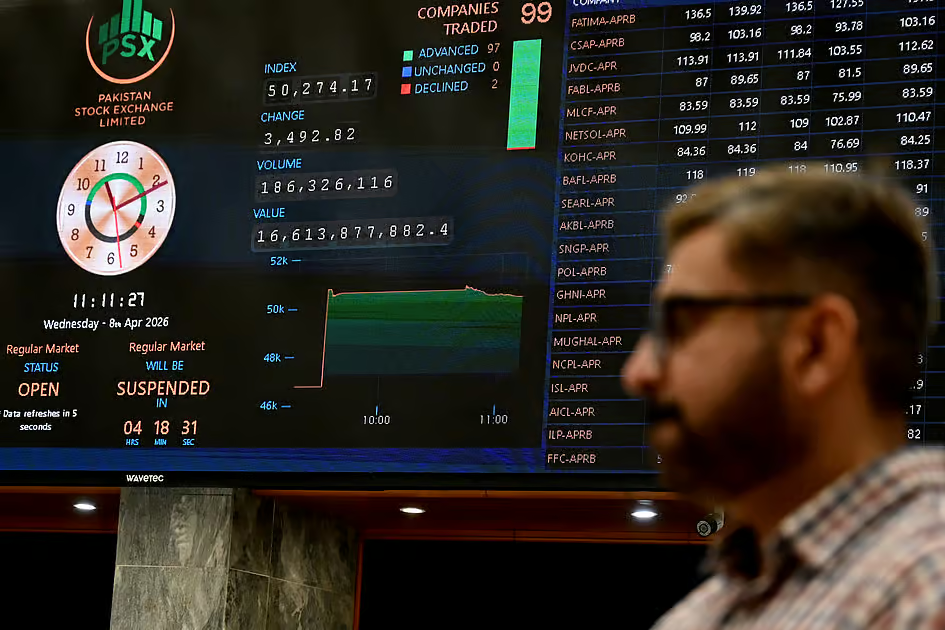
Pakistan’s stock market has delivered the best two-year run of any market in the world: a cumulative gain of more than 200 per cent in US-dollar terms over the two fiscal years to June 2025, per Bloomberg-sourced market reporting. Participation is broadening fast. PSX crossed 600,000 investors for the first time in July 2026, and after 23 straight months of net foreign selling, foreign investors turned net buyers that month, purchasing $34.4 million (Rs9.6 billion) net, led by banks.
The real economy confirms the signal: readymade garment exports, Pakistan’s highest-value textile export category, hit a record $4.18 billion (Rs1.16 trillion) in FY26, more than doubling over the past decade at a 7.8 per cent CAGR.
Few grasp Pakistan’s scale. At roughly 259 million people, it is the fifth most populous country on earth.
Yet up to 80 per cent of that population lacks reliable access to safe drinking water, according to the Pakistan Medical Association, and chronic kidney disease affects 15-20 per cent of adults over 40, with 25,000 to 50,000 new end-stage renal cases projected this year alone.
The same pattern runs through what the country produces and mines: basmati rice, pink Himalayan salt, jaggery, copper, gold and gemstones including aquamarine, topaz and emerald. Reko Diq alone holds one of the largest untapped copper-gold deposits in the world. Yet despite this natural wealth, Pakistan has long exported it raw, letting the processing, branding and margin be captured elsewhere. That is the opportunity: building inbound, for one of the largest and youngest populations on earth, instead of shipping raw material out.
Two years ago, calling Pakistan one of the world’s most compelling equity stories would have sounded contrarian. Today the numbers make the case on their own. Markets do not create generational opportunities simply because share prices rise. They create them when capital, confidence and entrepreneurship converge, and businesses can build at a scale that was not possible before. That is what is happening in Pakistan now.
Owning the value chain
Pakistan has a home-grown template for this kind of building, and the numbers behind it are larger than most readers assume. By group revenue, Engro Holdings leads at roughly Rs598 billion (~$2.15 billion) consolidated in CY2025, spanning fertilisers, energy, petrochemicals, food and infrastructure.
Lucky Cement, the flagship of the Yunus Brothers Group, follows at roughly Rs450 billion (~$1.62 billion) in FY2025, built from cement into autos, chemicals and energy. Sapphire Group reports more than $1.35 billion (~Rs375 billion) in annual revenue, including over $1.15 billion from textiles and more than $200 million from energy, across 35,000- plus employees.
Nishat Mills, the textile flagship of the wider Nishat Group, reported Rs178 billion (~$640 million) in FY2025, a fraction of the group’s true scale once its bank (MCB), cement, insurance, power and hospitality arms are counted. They have the same underlying fundamentals: capabilities, capital and distribution compound more powerfully when complementary businesses reinforce one another.
The opportunity in Pakistan today is to build the same way: vertically integrated, deep and closely networked businesses, rather than isolated, single-sector plays.
Why Pakistan is unique
The greatest investment opportunities rarely appear where every asset has already been discovered and efficiently priced. They appear where capital, entrepreneurship and institutional reform begin moving in the same direction.
That same young population is low-cost to employ, a massive operating-margin opportunity for anyone building at scale, while a significant, cash-rich local wealthy class commands real purchasing power. Both sit across entire sectors that remain underbuilt. In mature economies, incumbents own most of the infrastructure. In Pakistan, much of it can still be designed for the future rather than inherited from the past.
This is where I see a decoupling between politics and economics. The headlines still run on political volatility, currency pressure, policy execution and uneven governance, and a serious investment thesis must acknowledge all of it.
But the market and macro story has been shaped by different forces entirely: a stabilising currency, an IMF-anchored reform programme, falling inflation, aggressive monetary easing and a widening base of retail and institutional participation. Risk and opportunity are not opposites. In emerging markets, the return often lies in understanding which risks can be structured, governed and managed, which cannot, and in recognising when a market’s economics have begun moving independently of its politics.
Built locally, scaling fast
The same conviction shows up bottom-up, in businesses built for Pakistanis rather than for export. DVAGO, the pharmacy chain led by Rizwan Diwan, has grown to roughly 95 stores across the country and is targeting more than 130 by the first quarter of 2027. “Focus on the customer and delivering them an excellent customer experience will always remain the driving force behind everything we do,” Diwan says.
Fresh Basket, Karachi’s premium fresh-grocery format, often likened to Erewhon, has grown to six branches and is eyeing expansion beyond the city. Daftarkhwan, the coworking operator, has scaled to a dozen sites across Lahore, Islamabad and Rawalpindi, is entering Multan, and is reportedly close to a Karachi launch alongside a merger with a major international workspace operator, a combination said to target 100 coworking locations.
Banking tells the same story: of the five digital-only retail banks the State Bank approved in 2023, HugoBank, Raqami Islamic Digital Bank, Mashreq Bank Pakistan, Easypaisa Bank and KT Bank Pakistan, three are fully live and generating deposits, and HugoBank entered pilot operations in August 2026, with KT Bank Pakistan preparing to follow. That is a national digital-banking system built from framework to first customers in under two years.
None of this is stock-market noise. It is what a young, underbanked population of 259 million looks like when capital and operators start building for it directly.
Recent issuances closing in seconds
The primary market tells the same story. Sitara Petroleum Service hit its cap price in 10 minutes in May, a then-record, raising Rs4.8 billion (~$17.3 million) in one of Pakistan’s largest private-sector IPOs.
Weeks later, Service Long March Tyres’ Rs4.17 billion (~$15 million) book was subscribed 16.7 times over and closed in a record five seconds. In August, Tasdeeq Information Services raised Rs450 million (~$1.6 million); its book-building tranche was oversubscribed 21.5 times and filled within two seconds, per Topline Securities, the transaction adviser.
When companies from credit analytics to tyres to fuel retailing draw this kind of demand within minutes of opening, capital formation is reaching beyond the index into the real economy.
The emerging-market story, replayed faster
Over the two fiscal years to June 2025, the KSE-100 delivered a cumulative dollar return above 200 per cent. Pakistan’s gains have come from a market with roughly $50 billion in capitalisation at the end of FY25. That gap between scale and performance is the opportunity: a market still small enough to re-rate again as more of the real economy migrates into transparent, investable public companies.
The writer is Founder & CEO of Haya Life Capital
Source: Khaleej Times