


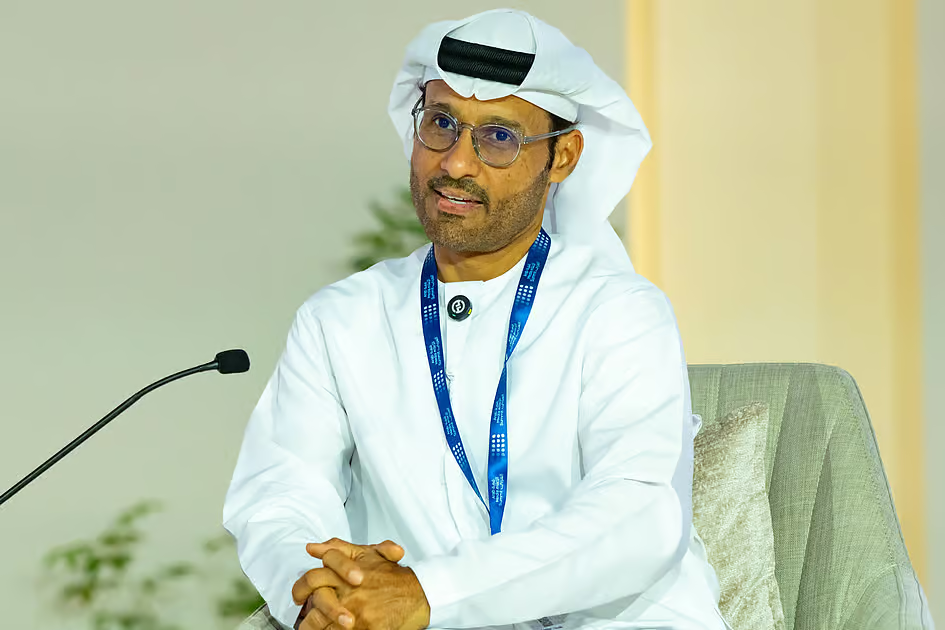
UAE recorded 640,000 cyberattacks in a single day, revealed Mohamed Al Kuwaiti, Chairman of UAE’s Cybersecurity Council, when speaking at a session titled ‘Media and Fifth-Generation Wars’ during the Arab Media Summit.
He said the impact of such attacks can go far beyond temporary service disruption, with hackers targeting data and critical sectors such as electricity, water and the economy. “Awareness is the first line of defence,” Al Kuwaiti said, stressing that people need to question the information they receive, identify its source and verify it before sharing it. He said the nature of cyber warfare was also changing, with attacks becoming increasingly decentralised and allowing individuals, including what he described as “lone wolves”, to create a significant impact. “A single person can, through fabricated or fake information, influence society and change the course of events,” he said.
$5 million ransom demand
Al Kuwaiti recounted a cyberattack involving a private-sector organisation in which a hacker exploited an unpatched vulnerability and subsequently demanded $5 million. The attacker claimed to have gained access to the organisation’s systems and threatened to expose its data. Cooperation between government and private-sector entities, along with international coordination, helped protect the organisation and respond to the attack, Al Kuwaiti said. The hacker nevertheless published some of the information on the dark web, highlighting how cyberattacks can cross borders and require cooperation between different countries and sectors.
Stay up to date with the latest news. Follow KT on WhatsApp Channels.
Child loses a year of school over deepfake abuse
The cybersecurity chief also highlighted the human cost of the misuse of digital technology, recounting the case of a child who was subjected to bullying and blackmail by a group of students using deepfake technology.
The incident resulted in the child leaving school for an entire year before efforts were made to rehabilitate her psychologically and socially. Al Kuwaiti warned that what may begin as a joke or prank using deepfake technology can have serious consequences.
“The result was a wasted year of a child’s life,” he said, highlighting the importance of parental oversight and greater awareness of the risks associated with digital technologies. He stressed that the solution was not to fear technology or avoid it, but to ensure it was used positively and responsibly, particularly by children and young people.
‘Paralysis of ideas is more dangerous’
Al Kuwaiti said the most concerning aspect of fifth-generation warfare was that it can move beyond targeting systems to targeting people themselves. “System paralysis can be restored and fixed, but paralysis of ideas and the brain, and what affects habits and values, is more dangerous,” he said.
He warned that harmful ideas spread online could contribute to extremism and terrorism, making cyberterrorism a challenge that requires continuous preparedness.
He also pointed to the role of misinformation during crises, saying groups seeking to mislead the public can exploit delays in official responses to spread their own narratives.
When accurate information is not communicated quickly, he said, it can create an environment in which large amounts of information circulate, making it difficult for people to distinguish fact from falsehood.
He said official briefings and announcements remain important tools for countering misinformation and providing citizens and residents with accurate information.
Media, public urged to verify AI content
Al Kuwaiti called on media organisations and members of the public to exercise greater caution when dealing with content created or altered using artificial intelligence.
Before governance frameworks and laws come into play, he said, individuals should “think twice” before publishing an AI-generated article, image or piece of information.
Media organisations must maintain credibility in their reporting, while members of the public should verify information through official and trusted sources before believing or sharing it, he said.
He also warned about the impersonation of media organisations and the hacking of accounts to publish false information, stressing that monitoring, investigation and verification have become essential in a digital environment without geographical boundaries.
‘A genie is out of the bottle’
Turning to artificial intelligence, Al Kuwaiti said the technology offered enormous opportunities, noting that around 95 per cent of its uses and engagements were positive. However, he stressed the need for policies and governance to ensure that the technology is used responsibly.
The UAE was among the early adopters of artificial intelligence and has worked to establish policies and frameworks governing its use, he said. “There is a genie that is out of the bottle, and we have to control it and harness it for good,” Al Kuwaiti said.
He urged influencers and content creators to rely on official sources, respect the values, traditions and heritage of society, and verify information before publishing it. Al Kuwaiti said the UAE’s approach was to remain open to global experiences while addressing challenges and turning them into opportunities for improvement.
He stressed that tackling fifth-generation warfare requires a partnership between governments, the private sector, media and society. The battle, he said, is no longer only about protecting systems and infrastructure, but also about protecting people’s awareness, ideas and ability to distinguish truth from misinformation.
Source: Khaleej Times