


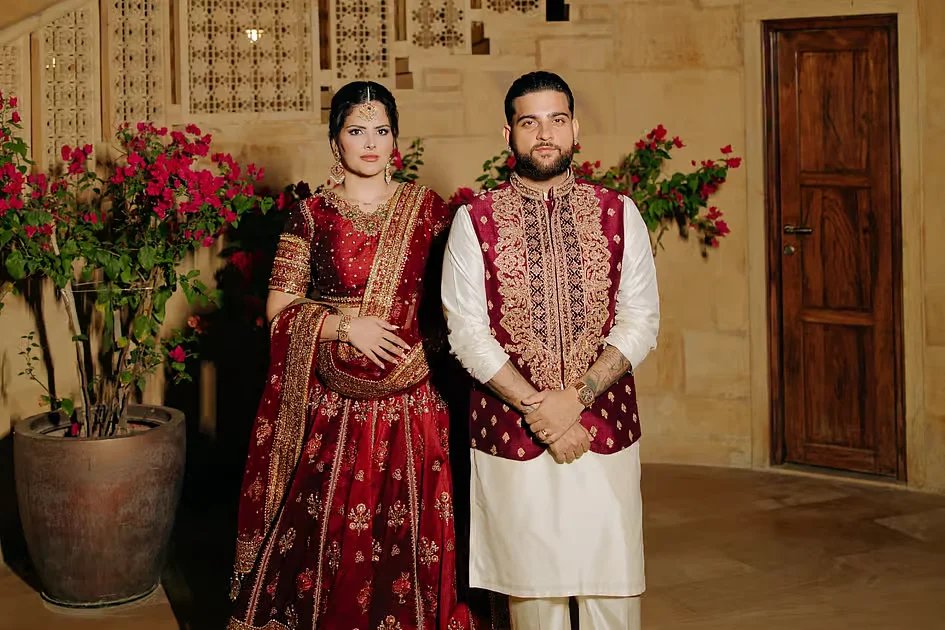
Cross-border collaborations have dominated fashion headlines more than ever. Gaurav Gupta dressing Beyoncé. Manish Malhotra crafting a custom for Naomi Campbell. Faraz Manan for Kareena Kapoor. These moments are powerful, sometimes commercially driven and occasionally genuinely personal. But when a global pop star chooses a designer for his own wedding, the calculus changes entirely. There are no brand synergies to calculate, no magazine covers being chased. It is purely about taste. About trust. About what you want to wear on the day that becomes memory.
That is precisely what made Mohsin Naveed Ranjha’s commission to dress Karan Aujla and his wife Palak for their wedding something worth paying attention to. Not because it happened, but because of what it signals about where Pakistani fashion is heading.
Mohsin Naveed Ranjha, or MNR as the label is known, did not arrive at this moment overnight. He is from Gujranwala, a city not particularly known for producing couture houses. He made his runway debut at Hum TV’s Bridal Couture Week, in a collection he now candidly admits was “unbelievably bad” and an overcrowded attempt to please everyone at once. But he kept going. He opened a flagship store in Lahore. He built a manufacturing unit back in Gujranwala. He learned, perhaps most crucially, to design only what he actually liked.
The international inflection point came in 2018 when Ranveer Singh appeared on the cover of Filmfare in an MNR design, a collaboration Mohsin had spent two years pursuing through the actor’s team, finally coming together around the time of the DeepVeer wedding. The collaboration announced something: here was a Pakistani designer with both ambition and the patience to see it through. Not long after, British Pakistani television personality Tan France wore an MNR custom jacket and pants for a South Asian evening, having discovered the brand through social media. France later posted about it, noting he had been the only one at the event in traditional clothing and he had chosen to be.
Sara Ali Khan would follow. So would Ranveer Singh again, in other contexts. And then Karan Aujla.
What is notable about Mohsin’s account of the Aujla wedding is how unforced the whole thing sounds. “When a brand consistently strives towards an authentic voice,” he reflects, “one of the most organic consequences of that pursuit is that it begins to align with individuals who share a similar aesthetic and cultural sensibility.” Palak Aujla, he says, took a strong creative lead in the process, not just for her own outfits but in shaping the visual narrative for her partner. There was “a certain creative openness” that allowed both sides to simply observe each other and respond.
This, in a way, is the MNR philosophy in miniature. Mohsin has never positioned himself as someone chasing Western validation or Bollywood access for their own sake. When asked whether dressing a global Punjabi icon feels more meaningful than a feature in a Western publication, he is measured but clear. “This form of recognition appears more meaningful and impactful than a conventional validation from the West,” he says, “as it emerges from a space of organic alignment rather than external endorsement.” One can, he points out, very easily imagine Karan and Palak in an MNR because the aesthetic fit is intuitive, not engineered.
That intuition has been sharpened by years of working across borders in an industry that has not always made it easy. For Pakistani designers, Bollywood has historically been both dream and closed door, coveted for the visibility it offers, but difficult to access without the right timing, the right room, the right moment of political thaw. Mohsin is pragmatic about this. “It is partly about relationships, about timing, and about being in the right room at the right time,” he acknowledges. The decline in structured fashion week platforms has reduced some visibility within the region, but it has not narrowed the horizon. His audiences are now in London, across the United States, across the Gulf. Geography, for MNR, is less a wall than a map still being drawn.
Dubai sits at the centre of that map in a way that is both personal and professional. Mohsin describes it as one of the most important meeting points for South Asians and for South Asian craftsmanship, a city that functions as a bridge across borders, allowing the label’s work to reach audiences in India and across the region. It is also, he says, somewhere he and his family are drawn back to time and again, beyond the logic of business alone.
His London store reflects a similar deliberateness. “When you establish yourself in a city like London,” he says, “you are not simply extending what you already have; rather, you are expanding your design language and your product to engage with an audience that is far more diverse and culturally layered.” He has an appointment-based presence in the United States. The brand’s reach, in other words, has been built one considered step at a time.
The diaspora customer is central to this conversation. What connects the bride in Lahore and the one in London, Mohsin believes, is a shared heritage, a common language of music, texture, and aesthetic memory. What differs is how those references have evolved in relation to distinct lived experiences. That dual attunement, he says, allows MNR to create work that resonates with local audiences and the South Asian diaspora simultaneously, feeling relevant and authentic to each on their own terms.
Underpinning all of it is the partnership between Mohsin and his brother Abubakar, who serves as Managing Director. Mohsin is candid about what each brings: he gravitates toward culture, design, and the emotional world of the brand; Abubakar translates vision into structure, scale, and operational discipline. “A creative vision without strategy risks remaining an idea,” Mohsin says, “while scale without a clear creative direction risks becoming indistinguishable.” What holds MNR together is that neither side of that equation is allowed to win outright. Building alongside a sibling, he adds, brings its own kind of trust, an instinctive shorthand that no formal arrangement could quite replicate.
On the broader question of South Asian craft and its place in the global luxury conversation, Mohsin is both proud and watchful. He acknowledges that appropriation without acknowledgment has often been the first move from Western houses. But he holds a cautious optimism, suggesting that such moments have at times marked the beginning of a broader shift towards correctly naming and situating cultural elements. He is confident that South Asia is “an increasingly important stakeholder within the wider fashion landscape.”
It is a confidence that extends to his own ambitions. When the conversation turns to what it would take for MNR to achieve the kind of enduring global luxury positioning that designers like Sabyasachi are now chasing, Mohsin does not hesitate. “I believe we are already in the process of taking those next steps.” He speaks of expanding into a comprehensive luxury lifestyle space including furniture, jewellery, and new brand verticals, while situating that ambition within a longer history. “Our ability to envision and pursue these directions is built upon the foundations laid by the generations before us,” he says, a nod to names like Bunto Kazmi, who in his view operated at a level that contemporary frameworks of success do not always know how to measure.
The boy from Gujranwala, as his PR circle used to pitch him to editors, has long since outgrown that peg. Eight years, a London store, a Tan France custom jacket and pants, and now the wedding clothes of one of South Asia’s most beloved musicians, all built on the conviction that if you develop a voice worth hearing, the right people will eventually find their way to it.
Karan Aujla did not choose Mohsin Naveed Ranjha because of a campaign or a connection or a feature in the right publication. He chose him because the aesthetic felt true. In fashion, as in music, that is the only validation that lasts.
Sadiq Saleem is a UAE-based writer and can be contacted on his Instagram handle @sadiqidas.
Source: Khaleej Times