


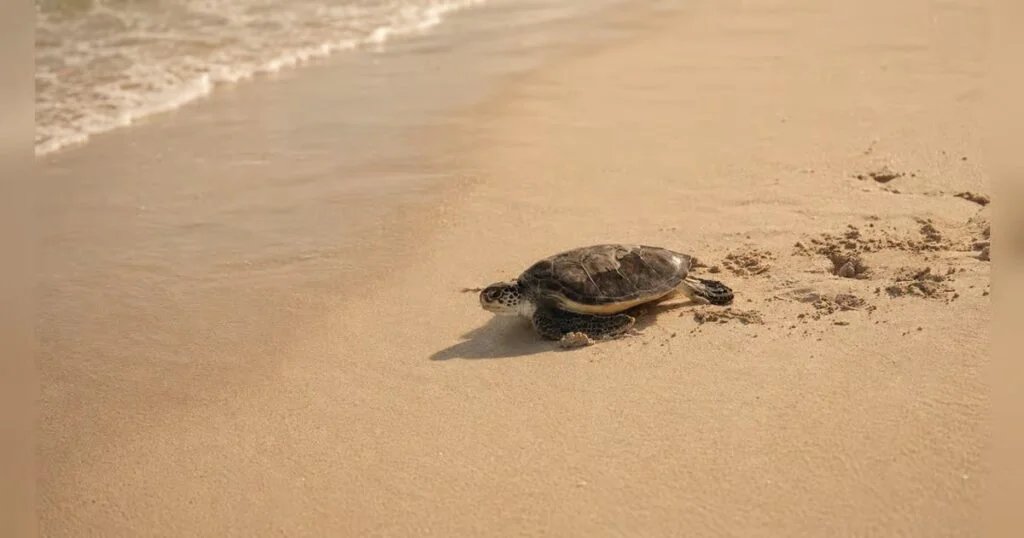
A green sea turtle that survived the loss of a front flipper and spent more than a year in rehabilitation has become the face of a major conservation milestone in the UAE.
Known as Foxy, the turtle was among 23 rehabilitated sea turtles released into the Arabian Gulf by Jumeirah to mark World Sea Turtle Day. But her return to the wild carried added significance.
Fitted with a satellite tracker before her release, Foxy became the 100th turtle to be monitored through the Dubai Turtle Rehabilitation Project (DTRP), a milestone that conservationists say will help deepen understanding of marine life across the region.
For many involved in the programme, Foxy’s story reflects both the challenges facing sea turtles and the impact of long-term conservation efforts.
The green turtle was rescued by a fisherman off the coast of Ras Al Khaimah in January 2025 after losing a front flipper. Injuries of this nature often leave turtles vulnerable in the wild, affecting their ability to swim, feed and avoid predators.
By chance, DTRP Ambassador Sheikh Fahim Al Qasimi was in Ras Al Khaimah at the time and personally transported the injured turtle to Dubai, where she began a lengthy rehabilitation journey.
Over the following months, veterinary specialists and marine conservation teams worked to help Foxy regain strength and adapt to life with a permanent disability. Despite the loss of a flipper, she gradually demonstrated strong swimming abilities and an ability to thrive independently, paving the way for her eventual release.
Her story culminated this week as she disappeared beneath the waters of the Arabian Gulf, carrying a satellite transmitter that will allow researchers to follow her movements in the months and years ahead.
“Every turtle we release carries a story of recovery and represents a learning opportunity for us,” said Barbara Lang-Lenton, Executive Director of Biodiversity at Jumeirah. “Each one gives us insight into the health of our marine ecosystems, and every turtle we track helps deepen our understanding of marine life in the Arabian Gulf.”
Foxy was one of 23 sea turtles returned to the wild during the World Sea Turtle Day release. The group consisted largely of green turtles, along with one young hawksbill turtle, many of which had undergone months of treatment after suffering injuries caused by boat strikes, entanglement, plastic ingestion and other threats increasingly affecting marine wildlife.
Their rehabilitation took place through the Dubai Turtle Rehabilitation Project, one of the Middle East’s longest-running marine conservation programmes. Founded by Jumeirah in 2004, the initiative has now rescued, rehabilitated and released more than 2,350 sea turtles back into their natural habitat.
What began as an effort to help injured turtles has evolved into a broader conservation and research programme. The satellite-tracking initiative, which has now surpassed 100 monitored turtles, has generated valuable data on migration routes, feeding grounds and habitat use throughout the Arabian Gulf and beyond.
Tracked turtles released through the programme have travelled thousands of kilometres across regional and international waters, helping scientists build a clearer picture of turtle populations and movement patterns.
Alongside its turtle conservation work, Jumeirah has expanded its focus on wider marine ecosystem restoration. Through a partnership with Dubai Reef, coral restoration projects at Jumeirah Al Naseem and Jumeirah Marsa Al Arab have already produced more than 9,000 coral fragments, with plans to exceed 10,000 by the end of June.
Yet it was Foxy’s journey that captured the spirit of the day.
Source: Khaleej Times