


When a Sharjah resident saw her five-year-old son putting a small magnetic bead in his mouth, she reacted the way many parents would.
Completely alarmed, she immediately snatched the object away, believing that the danger has passed since she acted quickly. But what she did not realise was that dozens of tiny magnets had already entered her son’s body and for the next few weeks, life appeared normal.
The boy occasionally complained of discomfort and suffered episodes of vomiting, but each time the symptoms improved on their own. To his family, it seemed like nothing more than a passing illness.
Stay up to date with the latest news. Follow KT on WhatsApp Channels.
It appeared that 52 magnetic beads were silently causing serious damage inside his intestines. It was only when the vomiting returned for a third time and the child became weak, dehydrated and unable to keep food down that his parents rushed him to NMC Royal Hospital Sharjah.
His mother still remembers the moment they met Dr Ramia Dalati, consultant paediatrician at the hospital. “The doctor immediately recognised that something wasn’t right. She insisted on admitting our son without delay and starting intravenous fluids. “Looking back, that decision may have saved his life,” she said.
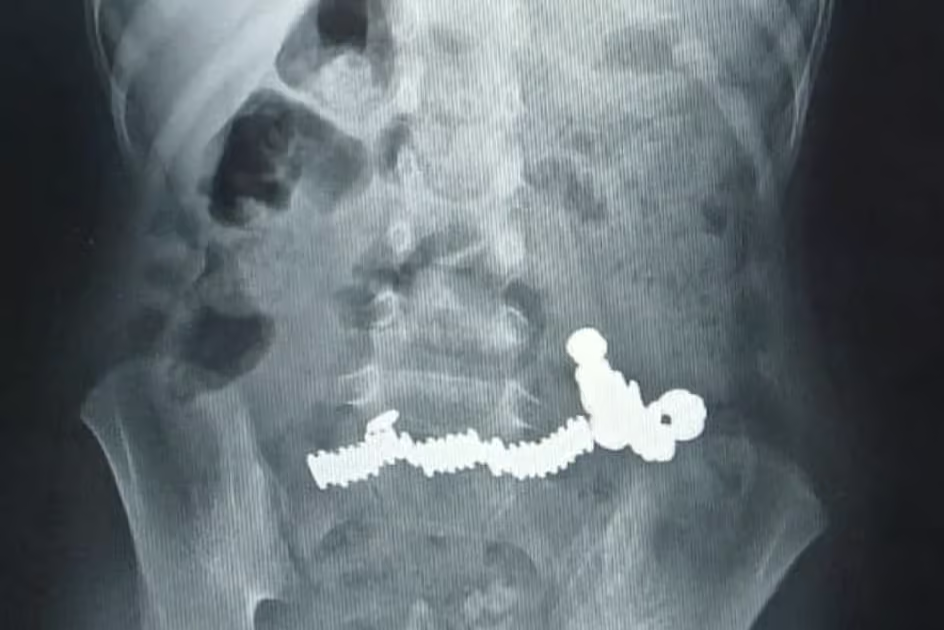
An X-ray soon revealed something unusual; a chain-like object inside the child’s abdomen. Further scans confirmed the shocking reality as dozens of magnetic beads were lodged deep inside the boy’s small intestine.
Doctors initially attempted to remove them through an endoscopic procedure, but the magnets were too far inside the digestive tract. As the child’s condition worsened, surgeons prepared for an emergency operation.
The following morning, at 2.15am, a multidisciplinary team entered the operating theatre. What they found was far more serious than expected.
Silent injury
The 52 magnetic beads had attached themselves across different loops of the intestine, trapping tissue between them and causing progressive internal injury.
“When magnets attract each other through separate loops of bowel, they can trap tissue in between,” said Dr Wissam Tamer, consultant paediatric surgeon at NMC Royal Hospital Sharjah. “The injury continues silently inside the abdomen even when a child appears relatively well.”
The surgery revealed multiple holes in the bowel, severe inflammation and infection. Despite the complexity of the case, surgeons successfully removed all 52 magnets and repaired the damage without removing any part of the child’s intestine.
“It was certainly a challenging operation. But one of the most rewarding aspects was being able to preserve the child’s bowel despite the extent of the damage we encountered,” said Dr Wissam.
Following the surgery, the boy spent several days in intensive care under the supervision of Dr Deepika Gandhi and the PICU team and gradually, he began to recover.
Within days, he was eating again, regaining strength and returning to his cheerful self. For his parents, the experience remains difficult to comprehend.
“We thank God every day that our son is safe,” his father said. “From the moment we arrived at NMC Royal Hospital Sharjah, we placed our complete trust in the medical team, and they exceeded every expectation,” they said.
Doctors said that the case serves as a reminder that some of the smallest objects in a child’s environment can pose the greatest dangers. “When it comes to magnets, seeking medical attention immediately can make all the difference,” said Dr Wissam.
Source: Khaleej Times