


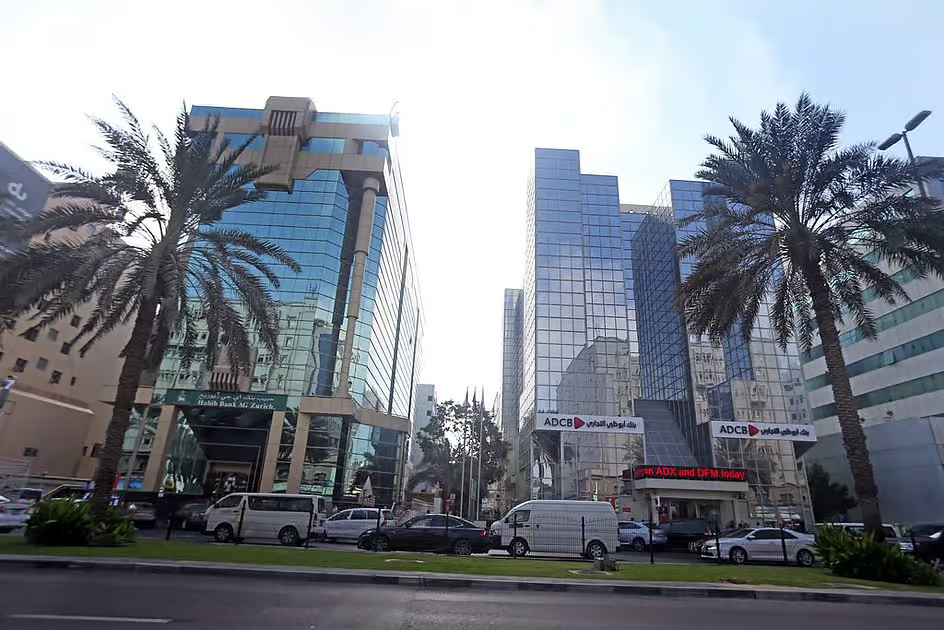
The UAE banking sector has emerged from the Middle East conflict with its resilience intact, supported by abundant liquidity, strong capitalisation and swift intervention by the Central Bank of the UAE (CBUAE), according to S&P Global Ratings and Fitch Ratings.
Despite weaker economic activity, disrupted trade and softer tourism during the conflict, both agencies believe UAE banks remain among the strongest in the GCC and are well positioned to absorb the fallout with only limited pressure on asset quality and profitability.
The latest CBUAE data underscores that resilience. Total banking assets climbed 17.7 per cent year-on-year to Dh5.56 trillion at the end of the first quarter of 2026, while gross credit expanded 20.3 per cent to Dh2.7 trillion. Customer deposits increased 17.4 per cent to Dh3.45 trillion, and broad money supply (M3) rose 17.7 per cent to Dh3.41 trillion, highlighting continued confidence in the country’s financial system despite geopolitical uncertainty.
Stay up to date with the latest news. Follow KT on WhatsApp Channels.
S&P said banking-sector deposits rose a further 4.9 per cent during the first four months of 2026 compared with the end of last year, driven primarily by government and public-sector entities.
Government deposits increased by 13.6 per cent, and public-sector deposits climbed by 14.6 per cent, significantly strengthening banks’ funding profiles.
As of April, UAE banks held around $73 billion in domestic investments and approximately $187 billion in deposits with the CBUAE. More importantly, their net external asset position reached about $233 billion—equivalent to roughly 40 per cent of total domestic loans—the strongest ratio among GCC banking systems.
According to S&P, this gives lenders substantial capacity to absorb capital outflows and withstand periods of market stress.
The central bank has also played a critical stabilising role by expanding access to reserve balances, providing additional liquidity facilities in both dirhams and US dollars, and temporarily easing certain regulatory liquidity requirements.
Borrowings from the CBUAE increased to Dh31 billion by April from just Dh1.1 billion at the end of 2025, reflecting banks’ precautionary use of liquidity facilities rather than signs of financial distress.
Capital levels remain comfortably above regulatory requirements. The aggregate capital adequacy ratio stood at 16.8 per cent at the end of March, well above the Basel III minimum of 13 per cent, while Tier 1 capital reached 15.7 per cent. Banks also maintained a surplus liquidity of about Dh181 billion with the central bank, providing an additional buffer against financial market volatility.
Although banks remain exposed to sectors affected by the conflict, S&P believes risks are manageable. Lending to hospitality, trade, transport, construction, and real estate accounted for about 27 per cent of total loans at the end of 2025, down from 35 per cent five years earlier, reflecting greater portfolio diversification. Direct exposure to hospitality accounts for less than 1% of total lending.
The ratings agency expects the cost of risk for the largest UAE banks to increase to between 70 and 80 basis points this year, up from 49 basis points in 2025, as lenders adopt more conservative provisioning policies. Even so, the non-performing loan ratio for the country’s 10 largest banks remained stable at 2.4 per cent in March.
Mohamed Damak, head of Islamic Finance at S&P Global Ratings, said the UAE banking sector entered the crisis from a position of considerable strength after several years of robust profitability, healthier balance sheets and prudent risk management.
Fitch Ratings has reached a similar conclusion. It said UAE banks remain well placed to withstand the regional conflict, with stress tests showing that even if impaired loans were to triple or quadruple under a severe downside scenario, most rated banks would continue operating comfortably above minimum regulatory capital requirements. While real estate remains the largest area of credit exposure, Fitch noted that lenders have strengthened underwriting standards and diversified their loan books in recent years.
Outside banking, the insurance sector has also remained resilient. S&P expects insurance revenues to grow about 10 per cent this year after expanding 17 per cent in 2025, supported by strong underwriting, firmer premium rates and extensive international reinsurance coverage.
The conflict’s biggest financial casualty has been the sukuk market. UAE sukuk issuance plunged to just $3.6 billion this year from $22.1 billion in 2025, with most deals completed before geopolitical tensions intensified.
Damak said weaker investor sentiment, rather than deteriorating credit quality, has been the principal reason behind the slowdown. Fitch agreed, saying the decline reflects market uncertainty and reduced investor appetite rather than weaker issuer fundamentals. The agency expects sukuk issuance to recover gradually as geopolitical tensions ease and market confidence improves.
The combined assessments from S&P and Fitch suggest that while the conflict has disrupted capital markets and temporarily slowed economic activity, the UAE’s banking system remains exceptionally resilient. Supported by strong government backing, abundant liquidity, robust capital buffers, and proactive oversight by the CBUAE, the sector appears well-equipped to navigate continued geopolitical uncertainty while reinforcing the UAE’s position as one of the Middle East’s most stable financial centres.
Source: Khaleej Times