


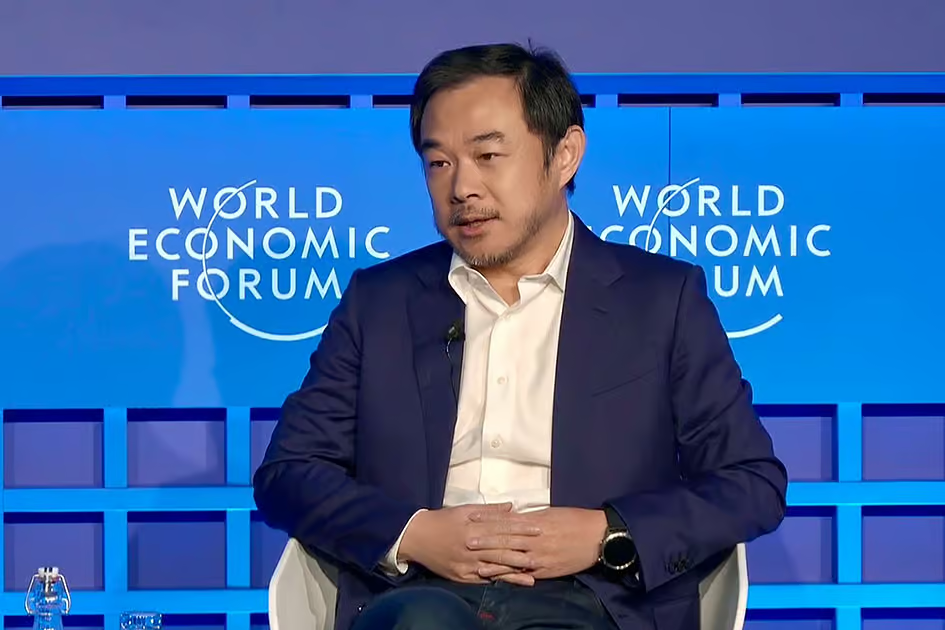
The office of Eric Xing, President and University Professor of the Mohamed bin Zayed University of Artificial Intelligence, does not look like what one would expect of a national technology nerve centre with supercomputers and screens attached to each wall. It, in fact, bears great resemblance to an impressive private library.
Among the shelves sits a 1485 edition of Euclid’s Elements of Geometry, one of the earliest printed versions of the text, which he calls a genesis of European science. Near it rests a first edition of Isaac Newton’s Principia, and a volume by Johannes Kepler, whose calculations of planetary motion gave Newton something to build on. The books aren’t there for decoration but in Xing’s telling, are an argument about what a university is for.
Stay up to date with the latest news. Follow KT on WhatsApp Channels.
“We want to use this university as a beacon of culture, of a mindset,” says Xing, turning one of the volumes in his hands. “We want to go back to the origin of the university, which is about learning and knowledge. It is not about everybody having fun and finding a way to cultivate ourselves with a diploma. It is about learning a great deal, sitting on it, and producing more of it down the road.”
It is an unhurried register for the head of an institution that is, by most measures, in a hurry. MBZUAI is five years old, ranked tenth in the world on the CSRankings index across its core AI specialisations, including computer vision, machine learning, natural language processing, robotics, and computational biology. Built into Masdar City, it serves as a deliberate centrepiece of the UAE’s bid to lead in the field. Xing is blunt about how he wants it seen.
“We don’t want to be looked at as yet another university,” he told Khaleej Times. “When you talk about MIT, about Carnegie Mellon, it is not yet another university. It is the university for a particular subject, the place you go for the genesis of new ideas. That is what MBZUAI is going to be.”
The particular idea he is chasing is that the AI most people have met so far is only the beginning. Xing divides intelligence into tiers, and the chatbot, the tool that has come to define AI in the public mind, sits at the bottom of them.
“The ChatGPT type of intelligence is what I call book intelligence. You learn from text and you deliver in text,” he says. “But you don’t learn to swim by reading a book. You learn to swim by jumping into the pool. That is physical intelligence.”
Physical intelligence, in his account, requires a different kind of system: a world model, trained to understand how the physical world behaves rather than only to describe it in words. It is the area where Xing places MBZUAI among a small group of global leaders and institutions: Yann LeCun of NYU and Fei-Fei Li of Stanford, and he makes a claim few people in his position would make.
“We are the only university in the world able to produce both large language models and world models,” he says. “No other university can do that.”
Above that sits what he calls agentic intelligence, the ability to act, collaborate, and break a large task into smaller pieces. “You cannot run a company on ChatGPT,” he says. “It can automate a job you have already specified. But if you say, make this company profitable, build a team of people and machines to do it, you need far more than knowledge from books, because these systems have to be trained through a simulation of the world.”
At the top is what he calls philosophical intelligence, the capacity to discover nature and design new things. This is where the ambition turns concrete. MBZUAI’s researchers have published their work on biological foundation models in leading scientific journals, and Xing now leads an effort he calls the AI-Driven Digital Organism, using world model architectures to simulate living cells and run experiments virtually, work he believes could change how medicines are discovered, designed, and tested.
That such work is happening in a country of fewer than eleven million people is, to him, the entire point. According to him, The UAE cannot win on population or industrial scale, It can win by being early.
“If we take the lead in using AI to solve hard problems, we bring the market, the adopters, and the investment here,” he says. “If we can transform drug discovery, pharmaceuticals, and finance through these models, those businesses have a reason to move closer to the centre of the research.”
For Xing, who spent his career in American research institutions before Abu Dhabi, the appeal of the place is the absence of friction. “Many people can say the right thing but never get the chance to turn it into reality, because of the culture, the politics, the legacy, or the limited resources,” he says. “Here the environment is more focused and more appreciated, by the public and by the leadership. I have a lot of ideas, and many of them can finally be put into practice.”
What he returns to, repeatedly, is the people he is trying to develop. He wants MBZUAI’s graduates to match or surpass the engineers turned out by the best American schools, and he describes it less as a strategy than a personal mission.
“The people here have a lot of potential that is not yet unlocked,” he says. “I want to unlock that. That is why we are here.”
The books will not stay in his office. When the university builds its museum, they will move there, on display for students who arrive long after the first models are built.
Source: Khaleej Times