


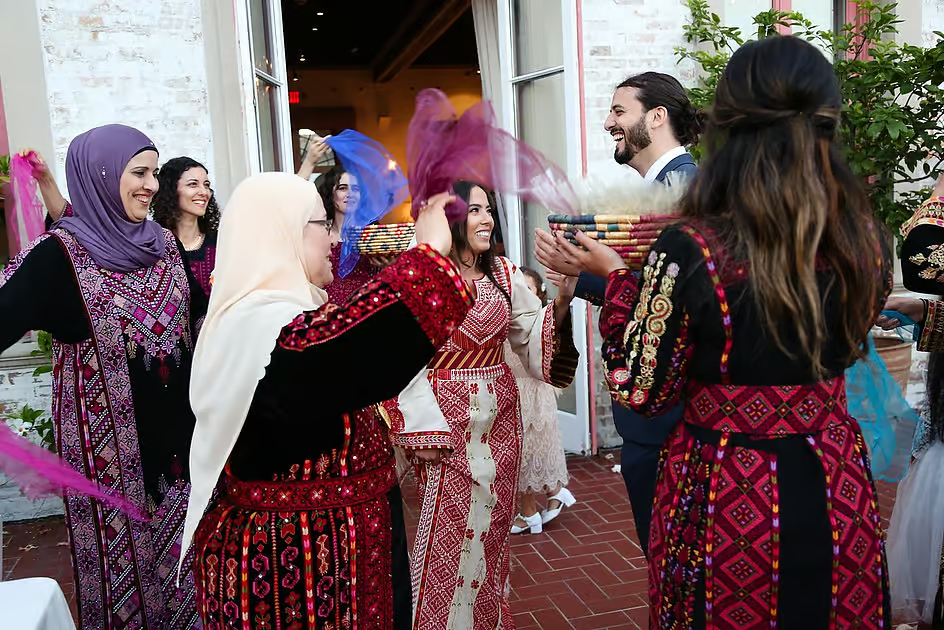
Scroll through Instagram long enough, or walk through independent pop-ups and concept spaces at Alserkal, and a pattern begins to appear: garments today refuse to hide their references.
Keffiyeh motifs show up on streetwear and accessories. Tatreez embroidery is blown up into bold graphic pieces on dresses and jackets. You’ll easily find watermelon symbols printed on T-shirts and bags. Lebanese designers are working maps of Beirut, old photographs, and fragments of Arabic calligraphy into clothing and jewellery. Fast forward, Syrian couture designers like Rami Al Ali translate Damascene architecture and memory into couture, where Syrian identity is present less as a direct symbol and more as an embedded reference shaping texture, silhouette, and embroidery on the runway.
Identity and heritage-driven design isn’t just sitting in the background anymore, it’s becoming the focus itself, worn directly on the body, and this isn’t limited to pop-ups or Instagram shops.
While $60 T-shirts with Palestinian, Lebanese, or Syrian references circulate widely online, identity-led design is also moving into a more formal register, appearing in emerging designers’ collections, regional fashion weeks, and increasingly in established retail spaces, where heritage is no longer just a graphic shorthand but a foundational design language.
The Reemami Halter Maqlouba Knitted Dress, which retails for around Dh2,500, is a clear example of how identity-driven design is entering the luxury fashion space in a more direct way.
The piece borrows its name from maqluba, which is a Palestinian dish that translates to “upside down”. It’s traditionally made by layering rice, meat, and vegetables, then flipping the pot so everything holds its structure once it’s turned onto the plate. That logic of layering and inversion becomes a loose conceptual reference in the design.
The silhouette stays clean and minimal, but the meaning sits in the textile, which in Palestinian embroidery, already works less as decoration and more as record-keeping. Under the chest, there is a purple floral motif placed, also emulated in other parts of the dress on the back to resemble different kinds of flowers, and is a direct nod to the art of tatreez, which is the traditional practice of Palestinian cross-stitch embroidery, where pattern, colour, and stitch can signal messages from the villages they derive from.
It’s this shift, from referencing identity to building it into the garment, that places the piece within a wider movement of diaspora and heritage-led design now moving through contemporary luxury fashion. Instead of flags or slogans, it pulls from a more embedded Palestinian visual memory. The print, part of the Tin of Olive Oil series, draws on domestic, everyday imagery: canned olive oil, household packaging, fragments of family ephemera. Objects that carry cultural weight not because they’re symbolic, but because they’re relatable and lived-in.
This kind of identity-driven language through art and fashion also resonates in the UAE more broadly, where expatriates make up about 88.5 per cent of the population. Within that, Arab nationals, including Egyptians and Levantine communities, are often estimated at roughly 15–20 per cent, though they aren’t tracked as a single official category.
“This piece has travelled to a lot of audiences from all over the world, not only the Palestinian ones that feel connected to it. It’s really about being a third culture kid, and it’s more about nostalgia — things we’ve grown up seeing in the ’90s, elements from Palestinian culture, old photos of my family, things I’ve seen in Palestine and Gaza. Meanings of freedom, flowers, cross-stitching, embroidery — Palestinian culture all merging together into one,” Reema Al Banna, founder of Reemami, said on how her collections intend to sit exactly in that space between memory and material. “Because of that, it’s translated well across different cultures and people from different nationalities, which has been great.”
This isn’t just an aesthetic drift. It reflects how fashion in the GCC is already structured around cultural segmentation and not a single “regional” consumer.
In Business of Fashion’s January 2026 Knowledge Report, Building Brand Resonance With Gulf Consumers, the Gulf fashion market is described as overlapping communities segmented by nationality, language, and cultural reference points, often framed in industry terms as “tribes” rather than demographics — meaning there are smaller identity-based groups shaped by shared cultural signals. In practical terms, it is a highly fragmented, expatriate-driven luxury and retail market where relevance is built at the level of cultural micro-communities rather than broad regional appeal.
Take Saudi Arabia, for example, where expats make up around 44 per cent of the population; over 60 per cent of Gen-Z consumers say they want brands to help them connect with their heritage in new and creative formats, according to a study by Euromonitor. In Gulf markets with highly global demographics, identity shouldn’t be seen as a niche aesthetic, but as a clear purchasing signal.
However, geopolitical contexts also have relevance when observing the demand for identity-driven art and fashion. “I think this shift has happened very organically, in response to what’s happening in the world right now. We’re witnessing cultures being erased, and so much violence and injustice affecting different communities,” Al Banna said.
“In moments like these, people naturally return to their roots. There’s a stronger need to hold on to where you come from, to come together, and to celebrate your identity. I think audiences are becoming more open and more aware, but it’s also coming from a very human place — people wanting to be more themselves than ever before, and not feeling the need to hide or dilute that anymore,” Al Banna added.
The Ghazal Al Banat, a pink slip dress, also from Reemami’s A Tin of Olive Oil collection, is another example of this shift, where identity is not referenced but built into the garment. Drawing on her Palestinian-Emirati heritage and childhood memory, the designer turns Levantine embroidery motifs and hand-drawn illustration into textile print, using symbols like a coastal octopus tied to Gaza or the UAE’s shoreline, a ‘1948’ textile in red font, and an orange vine that references orchards and domestic landscapes. The palette leans into a soft, nostalgic femininity, what in older Arabic popular culture might be flirtatiously described as ghazal al banat, which is a kind of playful, romantic charm carried through tone rather than ornament.
The silhouette is simple, the delicate pink slip cut sits close to the body with a clean neckline and a light, natural shape through the bust, giving it a quiet elegant sensuality without exaggeration. The surface carries the weight. Again, domestic references to olive oil tins and household items like an upside down pot are subtly reworked into fabric.
At the other end of this sits Emergency Room Beirut (ERB), founded by Eric Matthieu Ritter. Emergency Room Beirut began in 2018 after Ritter was inspired while doing NGO work in northern Lebanon and spent time in Tripoli’s secondhand markets, where overproduction, waste, and a lack of local artisan work became interconnected problems that birthed his vision for a clothing line. Since he started ERB, the brand has evolved despite the constant instability in Lebanon where he works on his designs. He also acknowledges that as a Lebanese national and artist, he has had to navigate political unrest, economic collapse, the 2020 Beirut port explosion, the Covid-19 pandemic, and seemingly endless regional conflict.
“It turned into this story of survival, one challenge after the other,” Ritter said. “I think that we really try to, through our work and through each connection that we put out there, catch and embody the spirit of Lebanese people and identity. It is mostly through the use of materials that really resonate with people from the area,” he said, referring to everyday domestic textiles like childhood bedsheets, family couch fabrics, and traditional woven materials that he reworks into garments.
That idea of recognition over symbolism was visible in the brand’s most recent work. On February 2, 2026, Emergency Room Beirut presented ‘Hey, what are you up to?’ in collaboration with the shoe brand Timberland at Dubai Fashion Week in a show that was staged on the basketball court in the Dubai Design District. The casual ‘everyday’, open space was intentionally selected to mirror the idea behind the title of the show — a casual phrase used to make plans in today’s modern age. Across the runway, viewers can see a clear thread of tulle, sharp tailored coats, white lace patterns, and patchwork, along with the marks of embroidery throughout.
“I like to always think that fashion is a spectrum,” Ritter said, nodding that to him fashion can range from the very utilitarian to pieces that simply exist to make a statement. “Once you understand that, then you start realising that if you do want to engage in conversations and dialogue and resistance, you can do it through clothes.”
That logic carries into pieces like the Double Breasted Heritage Coat, which retails at about Dh2,300, where the tailoring is sharp and yet nothing feels new in the traditional sense. It’s made from upcycled vintage textiles, where beige and white panels are stitched together and manipulated to create a pattern amid the dense collection of embroidery. The chest panels and arms are layered with floral and vine-like motifs — making the coat feel fully inscribed rather than simply decorated. Or in another piece, the Brocade Patchwork Tulle dress, which is made to order and fully unique for each buyer at around Dh4,070, jacquard and tulle are pieced together into a layered, semi-transparent surface. The dress shows off the colourful patchwork motifs of olive greens, pinks, and varying shades of beige that sit across the models chest and torso in almost a carpeted pattern. The whole piece feels deliberately assembled and lived-in, representing layered decoration that could easily echo a grandmother’s salon or living room. This, Ritter hopes, reflects the brand’s visual language rooted in Lebanon.
“The messaging is never direct. It doesn’t end up looking like something you would find in a tourist shop. But it will end up looking like something that people from Lebanon, Palestine, or Syria will recognise visually and will connect with because it will directly strike a nostalgic chord in their mind,” Ritter said.
That idea runs through much of ERB’s work. Rather than relying on obvious national symbols, the brand pulls from materials and visual references that feel familiar to people from the region: living-room upholstery, traditional woven fabrics, ironwork patterns found on Beirut balconies, staircases, and windows, and other fragments of everyday life that operate through recognition rather than explicit messaging.
Hala Khayat, a Dubai-based art specialist, curator, writer, and cultural consultant working across the Middle Eastern, Arab, Iranian, and Turkish art scene, with over 16 years in the region, frames it clearly: “Fashion is no longer orbiting, you know, around the art world. It’s really operating within it.”
Khayat is a regional director at Art Dubai, one of the leading art fairs in the GCC, and was named among the 100 most influential Arabs in art and culture under 40. She is also the co-founder of Safir, an NGO supporting Syrian artists.
“Today, more than ever, I see a lot in the region, people going back to their heritage,” Khayat said. “I think that this overlap between art, fashion, and cultural identity is becoming authoritative in the cultural art of today. It’s no longer on the surface level of aesthetics. It’s really tapping into deeper and empowering, especially the craftspeople who are working in these heritage communities.”
The appeal isn’t just cultural. Researchers writing in Ethnicity in the Fashion Business in 2026 found that heritage-driven fashion can strengthen brand loyalty and differentiation in a crowded market. But they also warned that the model comes with its own pressures, from finding skilled artisans to expanding production without reducing identity to a marketing tool. “Integrating cultural identity with slow fashion principles appeals to ethically conscious consumers, fostering stronger brand loyalty and market differentiation,” researcher Andy Wong writes.
Phillippa Kennedy, an expert and long-time figure in the Middle East’s luxury space where she’s worked across marketing and media strategy for leading beauty and fashion brands, agrees with Khayat that the more visible crossroads of culture and fashion has been long in the making. “I think it’s more that the industries are catching up and moving quicker than before with a more global lens. The appetite was always there, the supply side just wasn’t mature enough yet to make it feel considered rather than tokenistic,” Kennedy said.
Designers who studied abroad are now returning home and showing their work locally, and platforms like Riyadh Fashion Week are turning what used to be isolated moments into an established fixture, Kennedy explained. “For the first time there’s a proper pipeline that lets local identity become a finished product rather than just an idea.”
While heritage-led fashion may continue to gain mainstream popularity, it will likely stay somewhat niche, primarily serving the communities it directly speaks to, Kennedy argues. However, it is increasingly being acknowledged by major luxury houses as part of their wider strategy for high-value clients. Brands like Dior, with its Ramadan-focused ‘Dior Or’ capsule, and Prada, which collaborated with Emirati creatives on its Ramadan collection, show how global maisons are beginning to embed regional heritage more meaningfully rather than simply layering it onto existing designs, Kennedy explained.
“I saw this first hand leading the Ramadan campaign for Abercrombie & Fitch in the UAE, where the brief was not to translate the global campaign, it was to build something that actually spoke to the customer here and guide the wider team on what good practice looks like in this market. I had a similar experience at Prada Beauty, running Lunar New Year in the UK, where the challenge is almost the reverse, you’re not localising for the home market, you’re localising for a diaspora audience celebrating a heritage moment somewhere they don’t always see it reflected day to day,” Kennedy said, pointing to how localisation is now about building from culture, not just adapting campaigns.
Kennedy does warn though, that success is hard to measure in this domain because heritage-driven craftsmanship can build strong loyalty among people who deeply connect with a designer or collection through shared heritage but it can also narrow the audience in the process. “Designers will naturally create what speaks to them and it’s the customers who recognise themselves in that, who buy in.”
Source: Khaleej Times