


Before Kapil Dev emerged as a supreme fast-bowling all-rounder who had a beautiful outswing and an equally beautiful bat swing with which he put some of the most feared bowlers of his time to the sword, India was always known as the land of spin bowling.
Unlike most Test-playing nations until the late 1970s, India traditionally banked on their spinners’ turn and guile, especially on the slow wickets at home, to trap rival teams.
Spinners such as Bishan Singh Bedi, Erapalli Prasanna, Bhagwat Chandrasekhar, Anil Kumble and Harbhajan Singh would not have become iconic figures if their wonderful bowling spells had not been backed by their team’s batsmen, who possessed incredible wrists and an amazing ability to play the ball late.
From Sunil Gavaskar, Gundappa Viswanath and Dilip Vengsarkar to Mohammad Azharuddin, Sachin Tendulkar, Rahul Dravid, Sourav Ganguly, Virender Sehwag and VVS Laxman, India have had world-class batsmen against spin who conjured some of the most remarkable feats of batting to counter the threat of visiting spinners.
It was on the back of that combination of great spinners and great players of spin that India became one of the most difficult places for foreign teams to win in for several decades.
But that aura of near invincibility has collapsed quite spectacularly — not because Indian spinners are no longer good, but because India’s post-T20 era batsmen lack the technique and temperament of their legendary predecessors to bat for long hours against quality spin bowling.
Barring Rohit Sharma, even Virat Kohli, Cheteshwar Pujara and Ajinkya Rahane, who formed the backbone of the Indian middle order in the second decade of this century in Test cricket, struggled against spinners in home Test matches in the last few years of their career.
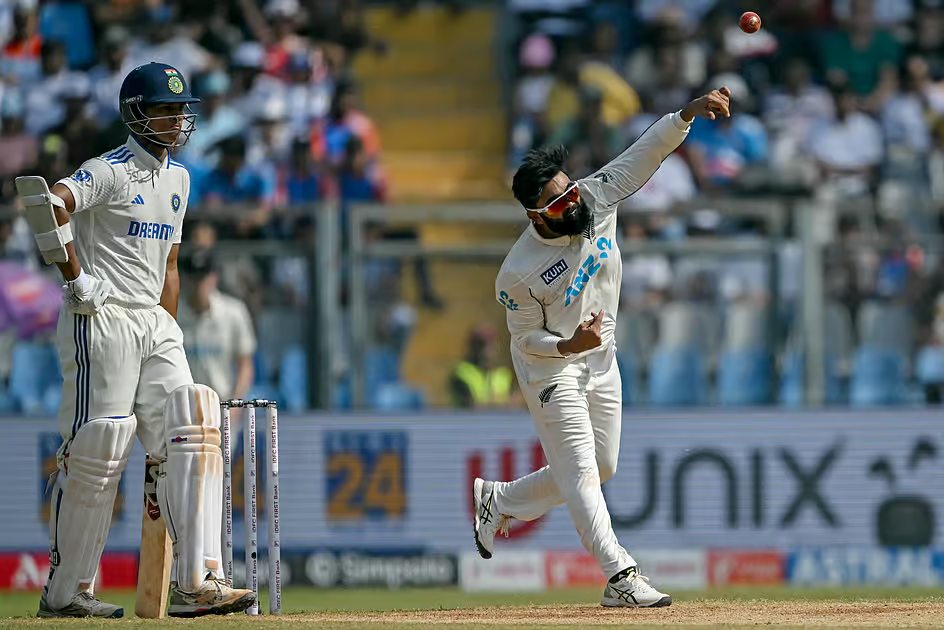
The crisis took an ugly turn in 2024 when New Zealand became the first team in history to achieve a 3-0 whitewash in India, as the home team’s batters were unable to find any solution to the Kiwi spinners.
Then last year, India slumped to a 2-0 home defeat to South Africa, the reigning World Test Championship winners.
Now, it is against this gloomy backdrop that India are preparing to take on Sri Lanka in a Test series.
Rohit, Kohli, Pujara and Rahane have now all retired — the last two from all formats.
The Indian team, led by Shubman Gill, is in a transitional phase. A Test series in Sri Lanka will be a big challenge for the Indian batters, as the Lankan spinners will relish their chance on those slow, turning wickets.
The Indian cricket board has sent four additional spinners — Harsh Dubey, Shivang Kumar, Tanush Kotian and Vipraj Nigam — to give the Indian batsmen more practice against spin bowling in net sessions.
Whether the additional hours of practice will help India’s attack-minded batsmen remains to be seen. The international cricket calendar, packed with white-ball matches, rarely gives India’s batsmen the opportunity to play domestic red-ball cricket.
The lack of red-ball match practice in domestic cricket is primarily the reason behind their struggles against spinners.
In skipper Gill, KL Rahul, Yashasvi Jaiswal and Rishabh Pant, India have some tremendous batting talent, but white-ball batting habits have crept into their Test batting.
There was a time when the likes of Tendulkar and Laxman could play out sessions with solid technique and temperament before playing shots against tiring attacks.
Today’s generation attempts to get out of tricky situations with counterattacks.
Sehwag was the master of this approach, doing it consistently against Shane Warne and Muttiah Muralitharan, two of the greatest spinners of all time, by hitting them against the turn on tricky surfaces.
The Nawab of Najafgarh was one of a kind and redefined the art of opening batting in Test cricket.
India’s new crop of batters is a treat to watch when demons do not appear from deteriorating tracks in Test cricket.
In Sri Lanka, the wickets are likely to be low and slow. On such surfaces, blasting the home spinners is a ploy Sehwag would have used devastatingly.
From the current generation, Jaiswal, an opener, has the game to take on the bowlers.
The 24-year-old left-hander has made an impressive start to his Test career. But for him to stake a claim as India’s next batting superstar in Test cricket, he needs to prove his temperament by converting starts into big scores.
The two-Test Sri Lanka series, which starts on August 15, will show us if he is ready to take the next step in the five-day format.
Source: Khaleej Times