


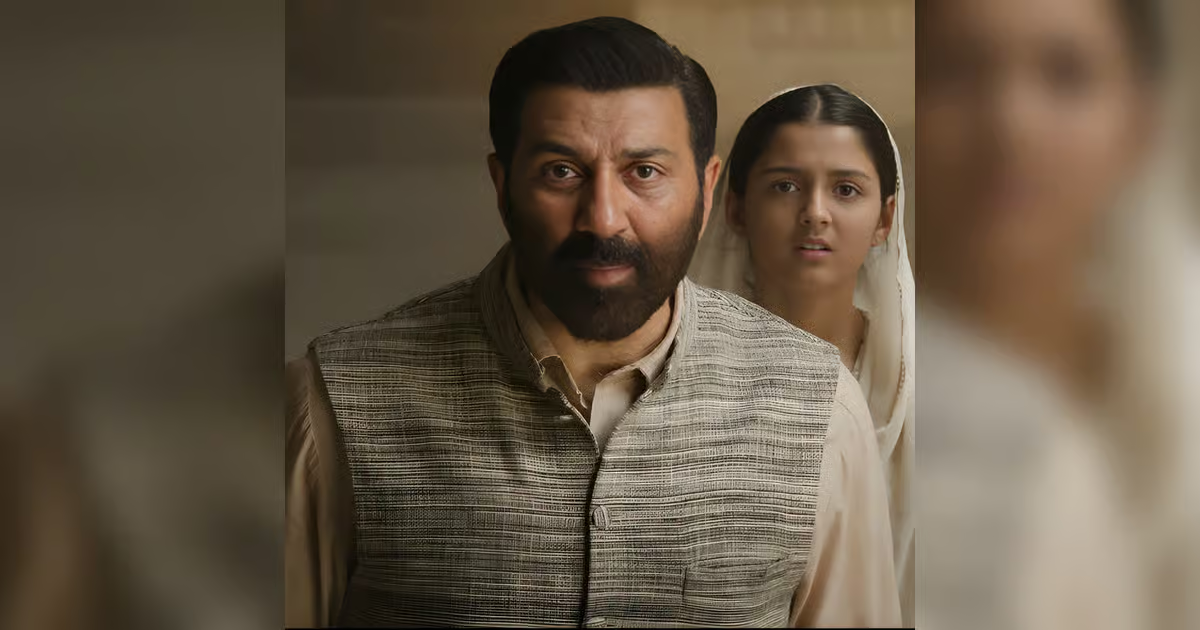
How do you counter polarising ideas in today’s world? Most importantly, can a film take on that responsibility? Adapted from Asghar Wajahat’s drama Jisne Lahore Nai Vekhya, O Jamya E Nai (‘Experiencing Lahore is so fundamental to a fulfilling life that not seeing it is akin to not being born’), Batwara 1947 is a new film that aims to tackle the conversation. Directed by Rajkumar Santoshi, the film is set during the tumultous Partition of India.
The plot revolves around a family that moves from one country to another to take possession of a house and encounters an old woman who refuses to leave. She refuses to accept partition and is adamant that she will not leave the home of her ancestors.
Sunny Deol, who plays the main protagonist, recalled his family’s own tryst with partition. “My father ( the late legendary actor Dharmendra) used to narrate stories of the partition that my grandfather used to tell him,” says Deol. “My grand-dad had once rescued a small Muslim girl during the riots of 1947 and they hid her in his home. And when the storm subsided, she made sure she reached her home safely. So, we have grown up hearing heroic stories of that time that are embedded in our hearts.”
Deol has not watched Wajahat’s well-known play. He says because he has been dyslexic, he does not read much. “I just passed my school exams by fluke,” he laughs.
But that did not stop him from becoming one of the most successful Bollywood actors of his time. When Sunny Deol comes on screen, he lights it up with his sheer presence. It has only helped that such roles have been written for him. “Writers are the main people. We just emote and say those dialogues,” he says. “Since I don’t read, I absorb the words, take it in, believe in it, make it mine. In short, I internalise it before expression. I don’t intellectualise it.”
He feels that cinema is a medium where every emotion can be seen or felt even if you understand the word or not. Juts the way the words are spoken can convey the meaning.”
When he watched his father, veteran actor Dharmendra’s films of ‘60s and ‘70s, he found them to have a great storyline. “I must have been four or five years old when I watched films such as Pyaasa, Mr and Mrs 55, Khamoshi, and more, and was drawn towards them.”
He recounts that when he started out, he was very choosy about the films he would do. “I was clear that I didn’t want to do ‘nautanki’ (caricaturish) films,” he says. However, he made his debut with a romantic film, Betaab (1983). “Yes, but I hardly did films like that after Betaab. Arjun was another powerful film. I have had the opportunity to have good characters to portray,” he adds.
How does he see his equation with Rajkumar Santoshi? “When he started out, Raj was assisting Govind Nihalani and was from ‘art cinema’. So, when we shot Ghayal, the producer had run away, but we decided to make it anyway. Incidentally, my father was shooting for an earlier film called Batwara in Jaipur, and I met Raj there and my dad loved the script and told me to add his name as the producer of the film. So, Ghayal was released under our production house Vijayta Films. That is why, during the promotions of this film, we did a small reel next to Hawa Mahal Jaipur, where it all began.”
After Ghayal came Damini. Sunny was not part of the film initially. “When I asked Kareem Morani and Bunty Soorma, they said they have a small role for me,” he laughs. That small role went on to become a career landmark.
Sunny played a lawyer in the film, who helps the titular protagonist get justice. “ The dhai kilo ka haath” (hand weighing 2.5 kgs) dialogue has remained stuck with me. I cannot do anything about it. In fact, the recent film Ikka has that dialogue spoken by Tilottama Shome,” he jokes. His third film with Raj was Ghatak, a deep-tooted subject and a great father-son relationship film.
What about the fourth film, Batwara? Did his father get to watch it? “Yes, dad saw the whole film, and loved it. It is a sensitive story and had to be told correctly. It is a sensitive story and had to be told correctly. We didn’t want to play to the gallery,” he says.
It was in 2010 that the story was narrated to Sunny, but we didn’t find a producer. Finally, they found Aamir Khan, who eventually produced it.
Observe the trailer carefully and you will see several Hindu characters being essayed by Muslim actors and vice versa. “That is because you are noticing it now. Earlier no one bothered that Dilip saab was Muslim and he was playing a Hindu role. These things have become prominent only now. The film celebrates cohesive oneness. It doesn’t bash anyone.”
Karan Deol, his son, also stars in the film. “It is a good role and his character grows with tragedy and emotional turmoil. The story is about how your inner strength comes out in moments of crisis and protects people.”
And how does he see courage? “Courage is when you stand for something that the society is scared of, and that is honesty in action,” he says. “Society is not ready to face honesty and that is why you need courage.”
Source: Khaleej Times