


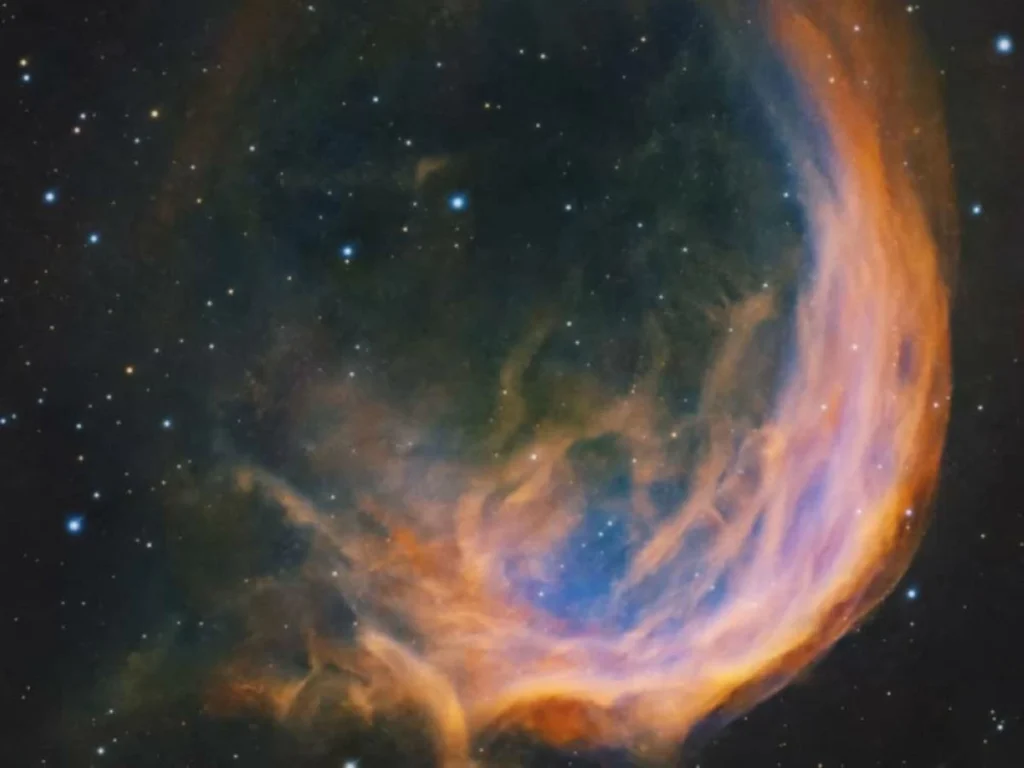
Al Khatim Astronomical Observatory reveals intricate details of a planetary nebula 2,770 light-years from Earth after more than 54 hours of imaging
ABU DHABI: The Al Khatim Astronomical Observatory, part of the International Astronomy Center and located in the Abu Dhabi desert, has successfully captured a remarkable image of the rare “Firefox Nebula”, revealing intricate details of its complex structure after more than 54 hours of astronomical imaging.
The nebula takes its name from its striking resemblance to the logo of the Firefox internet browser. Its brightest section appears as a spiralling arc of gas, while fainter surrounding gases complete the distinctive shape.
Located in the constellation Cassiopeia, about 2,770 light-years from Earth, the Firefox Nebula is classified as an ancient planetary nebula in an advanced stage of evolution.
Despite the name, planetary nebulae are not related to planets. They represent a late stage in the life cycle of low- and intermediate-mass stars, including stars similar to the Sun. During this phase, a star sheds its outer layers into surrounding space, leaving behind an extremely hot stellar core that eventually becomes a white dwarf.
Mohammed Shawkat Odeh, Director of the International Astronomy Center, said one of the nebula’s most distinctive features is its unusual shape.
“The Firefox Nebula does not appear as a regular, symmetrical ring like many planetary nebulae,” he explained. “Instead, it is characterised by a bright arc rich in gaseous filaments, with a fainter region on the opposite side and an elongated tail of diffuse gas extending behind it.”
According to Odeh, this asymmetrical appearance is the result of the movement of the nebula’s central star through the interstellar medium.
As material ejected by the star collides with the surrounding gas in the direction of travel, the gas becomes compressed and denser, creating the bright arc visible in images. Material drifting in the opposite direction forms a fainter region and an extended gaseous tail.
Computer models studying the nebula suggest the central star is moving through the surrounding medium at speeds of around 125 kilometres per second.
Detailed studies have shown that the bright arc visible in photographs represents only part of the nebula’s structure. A faint arc on the opposite side completes the ring, followed by a very faint and broad gaseous tail.
Together, these structures span around 15 arcminutes in the night sky. One study estimates the nebula to be approximately 22,000 years old.
The image was captured using the observatory’s 14-inch main telescope equipped with a monochrome camera. Because of the nebula’s faint appearance and the presence of light pollution, astronomers used three narrow-band filters to record emissions from hydrogen, oxygen and sulphur.
In the final image, hydrogen appears in red, oxygen in blue and sulphur in orange, allowing astronomers to distinguish the distribution of these elements throughout the nebula and reveal details such as gaseous filaments, the bright arc and surrounding faint structures.
The resulting image provides one of the most detailed views of the Firefox Nebula, illustrating how the interaction between material expelled by the star, the interstellar medium and the star’s movement through space has shaped its unique and asymmetrical appearance.
Source: Emirates 24|7