


Oil prices are expected to drop globally as crude oil exports from the UAE and the wider Middle East exceed pre-war levels in the last week of September.
Analysts said the Middle East war involving the US and Iran will also be instrumental in determining global oil prices.
Stay up to date with the latest news. Follow KT on WhatsApp Channels.
Provisional data from ship-tracking firm Kpler showed that crude oil exports from the Middle East exceeded pre-war levels on September 24 and between September 27 and 29, rising to between 19.5 million barrels per day and 22.5 million barrels per day, despite attacks on vessels passing through the Strait of Hormuz.
Exports averaged 18 million bpd between March 2025 and February 2026, before the US-Israeli war with Iran began.
“The recovery in Middle East crude exports shows how quickly the region has adapted to the disruption. Saudi Arabia has increased shipments through both the Gulf and the Red Sea following the restart of the East-West pipeline, while producers are increasingly using alternative routes and ship-to-ship transfers. At the same time, more crude is again moving through Hormuz despite the obvious security risks,” said Ole Hansen, head of commodity strategy at Saxo Bank.
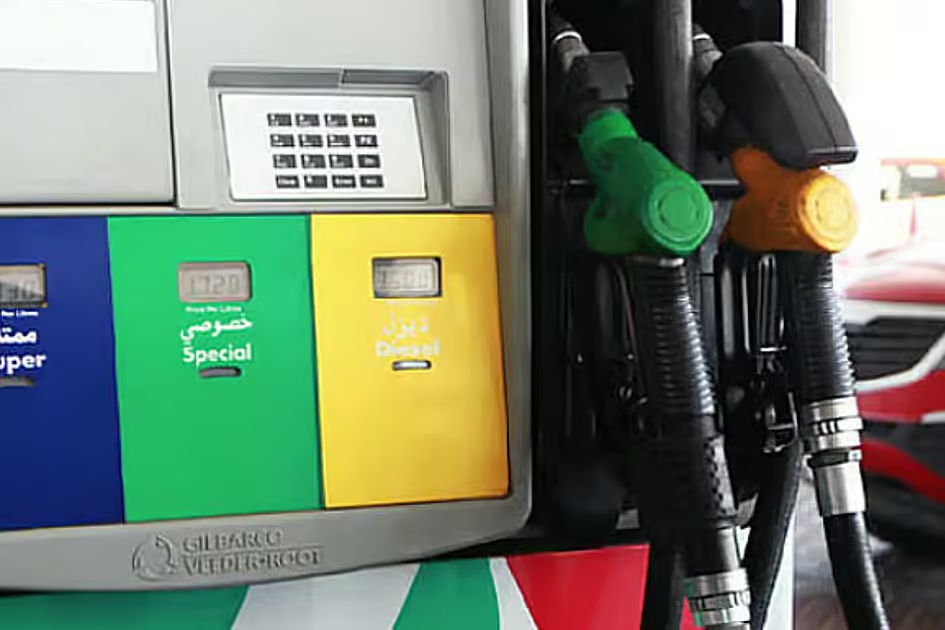
UAE fuel prices at over four-year high
Oil prices slipped below $100 a barrel on Monday evening but inched back up to $100 a barrel on Tuesday. WTI and Brent were trading at $89.71 and $100.60 a barrel, respectively, on Tuesday morning.
The UAE deregulated local retail fuel prices in 2015, and prices have since been revised on the last day of every month.
Prices crossed Dh4 per litre again in October 2026, the second time since 2022, when the price surpassed Dh4 per litre for the first time in the UAE following the Russia-Ukraine war.
For October 2026, the UAE Fuel Price Committee increased the price of Super 98 from Dh3.80 a litre to Dh4.40, Special 95 from Dh3.69 to Dh4.28, and E-Plus 91 from Dh3.61 to Dh4.21.
If global prices ease in October on the back of higher supply and an easing of the Middle East conflict, fuel prices will also drop in November 2026.
Fear premium fading
Dilin Wu, research strategist at Pepperstone, said oil prices carry a premium because of fears that the war could cut off a huge share of global supply. If exports continue to flow above pre-war levels, that specific fear is being priced out.
She said the easing was already under way but warned against reading too much into it. “What’s easing is the panic premium,” Wu said.
The structural premium, including insurance costs and war-risk surcharges on every voyage, would remain as long as ships continued to be hit, she added.
Attacks on shipping
The rebound comes despite a rise in attacks on vessels. A Kuwaiti very large crude carrier (VLCC) was attacked on October 1, according to a report by Maersk.
Wu said volume and risk were separate measures.
“The market has figured out how to keep moving oil through a war zone – it hasn’t made the war zone any safer,” she said.
Wu added that a meaningful share of traffic could involve vessels with their transponders switched off, which would not appear in the data. One successful strike on a fully loaded tanker, she warned, could reverse the repricing overnight.
Pressure on refined products
Hansen said the recovery had been much stronger in crude than in refined products.
Diesel and gasoline exports remain well below normal levels, while reduced Russian product supply and China’s decision to cut October export quotas are adding to the tightness.
“As a result, the main stress in the energy market has increasingly shifted from crude availability towards refining capacity and product supply,” he said. That could allow crude prices to ease while keeping diesel, jet fuel and refining margins relatively elevated.
Jordan Lawrence, CEO and co-founder of Damisa, said higher volumes did not mean normal conditions.
“The strain shows up in the cost of every trade: higher freight and war-risk insurance, longer compliance reviews, and payments that take longer to clear,” he said. That ties up working capital for traders and buyers, especially smaller importers in Africa and Asia.
Lawrence said prices could ease if volumes remained high and security improved in a lasting way.
“A durable de-escalation and fully normal transit through Hormuz could push prices down. Without that, crude remains exposed to upside risk,” he said.
Source: Khaleej Times