


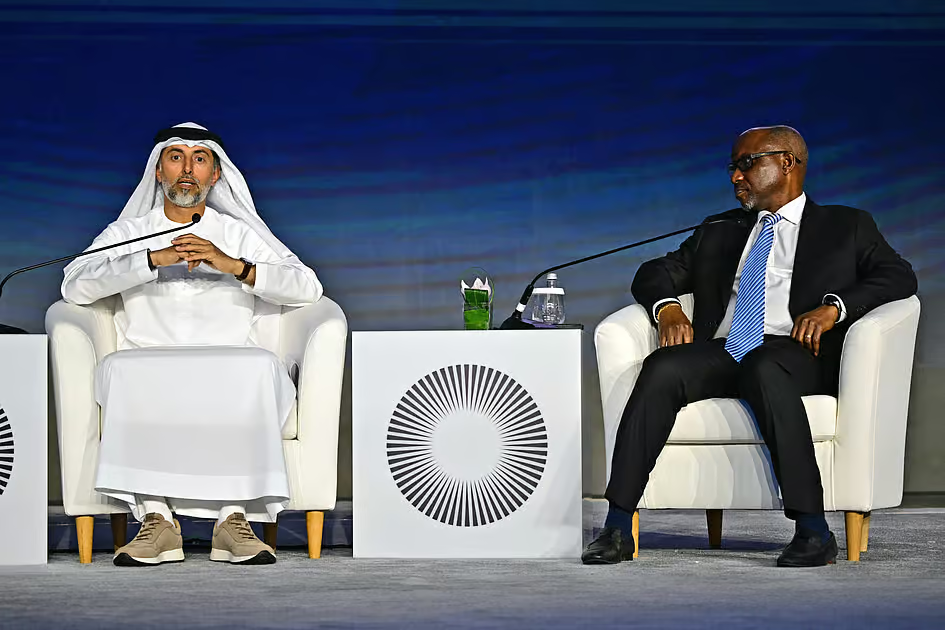
The UAE will review the design of its energy infrastructure, build additional layers of protection and increase spare capacity following the recent conflict, Minister of Energy and Infrastructure Suhail Mohamed Al Mazrouei said at ADIPEC on Monday, November 2.
Even if the situation returns to normal, the country cannot afford to return to business as usual when it comes to the design and protection of critical infrastructure, Al Mazrouei said during a panel discussion.
“We need to relook at those designs. We need to build additional layers to make sure that we have enough resiliencies and we need to build a spare capacity as well,” he said, referring to infrastructure across oil and gas, electricity and other energy sectors.
Stay up to date with the latest news. Follow KT on WhatsApp channels.
Artificial intelligence would also play a role in preparing the country’s infrastructure for future disruptions, helping engineers improve designs, assess different scenarios and identify ways to strengthen resilience.
“We cannot predict what’s going to happen, but I can tell you that we will be much more prepared than we were before,” he added.
The minister’s remarks point to a longer-term reassessment of the UAE’s energy infrastructure following attacks and threats during the recent regional conflict, with preparedness becoming a greater priority even if hostilities do not resume.
Asked about the possibility of another round of military action and threats against energy infrastructure and data centres, Al Mazrouei said countries must prepare for the worst regardless of what happens next.
“We will assume the worst and hope for the best.”
He added that the UAE would not rely on assurances from others that its infrastructure would be protected or left unharmed.
“It’s not only those who wear the uniform are entrusted to just defend the country,” he said, adding that residents, including expatriates, had played a role in helping organisations respond to the crisis.
“The nationals as well as the expats who are living with us here, everyone had a role in these organisations and everyone stood up to the challenge.”
Diversification and clean power
Al Mazrouei also linked the UAE’s approach to energy security with its investment in renewable energy, arguing that diversifying electricity sources would help the country meet future demand while reducing its vulnerability to disruption.
He pointed to Abu Dhabi’s round-the-clock renewable energy project, which combines 5.2 gigawatts of solar photovoltaic capacity with 19 gigawatt-hours of battery storage to deliver one gigawatt of uninterrupted clean electricity.
The project, developed by Masdar and Emirates Water and Electricity Company, reached financial close in July, with a total investment of $6.1 billion. It is targeted to become operational in 2027.
Al Mazrouei said the project demonstrated how renewable energy could become a reliable source of electricity rather than simply supplementing conventional generation.
He said the electricity would be delivered around the clock at a price he described as cheaper than energy prices today.
The minister also said the UAE had raised its 2030-2031 clean-energy target from 30 per cent to 35 per cent, adding that the country could exceed the revised target.
The 35 per cent target, which covers nuclear and renewable energy, was announced by Al Mazrouei in September. He said achieving it would require additional projects and greater private-sector participation.
AI intensifies competition for electricity
The minister said the growing electricity requirements of artificial intelligence and data centres would add another dimension to global energy competition.
He referred to comments by OpenAI chief executive Sam Altman identifying energy as a major challenge for the technology industry, saying countries would increasingly compete to provide sufficient electricity, whether generated from fossil fuels or cleaner sources.
“I think the energy and infrastructure will win. We will cope with the requirements,” Al Mazrouei said, adding that policymakers needed to make it easier for investors to bring forward projects and provide additional capacity for data centres.
He said countries that could offer cleaner energy and sufficient additional electricity capacity would be better positioned to attract investment in data centres.
The minister also identified Africa as a region with considerable untapped renewable energy potential, saying investment-friendly government policies would be important in unlocking large-scale projects.
UAE companies, including Masdar, were already active in renewable energy developments internationally, he added.
Cost of preparedness
Al Mazrouei argued that the recent crisis had demonstrated the financial value of investing in infrastructure resilience before a disruption occurs.
He acknowledged that preparedness, crisis management and readiness required investment, describing them as a collective effort that came at a cost. However, he said the consequences of failing to prepare could be many times more expensive.
“This is a collective work and it’s a business and we have a cost. And I think everyone understands now the value of it,” he said.
“If you are not prepared, you will pay 10 times,” he added, stressing that the cost of readiness had to be weighed against the potential losses when critical infrastructure was disrupted.
He argued that additional infrastructure investments and contingency arrangements could prove their worth when they were needed, rather than being viewed simply as costs that could be postponed. “Invest in a resilient infrastructure, that’s what we need for the future.”
The discussion comes as the UAE and other Gulf energy producers reassess the vulnerabilities of critical infrastructure and international supply routes following disruption to the Strait of Hormuz and attacks on regional energy facilities.
During the conflict, UAE energy infrastructure, including the Habshan gas processing complex, Ruwais industrial facilities, Shah gas field and Fujairah export terminal, experienced attacks, fires or operational disruptions.
The minister’s comments echoed a wider call at ADIPEC for countries to invest in supply buffers, infrastructure and alternative routes to market, as global energy markets contend with the consequences of the disruption.
Source: Khaleej Times