


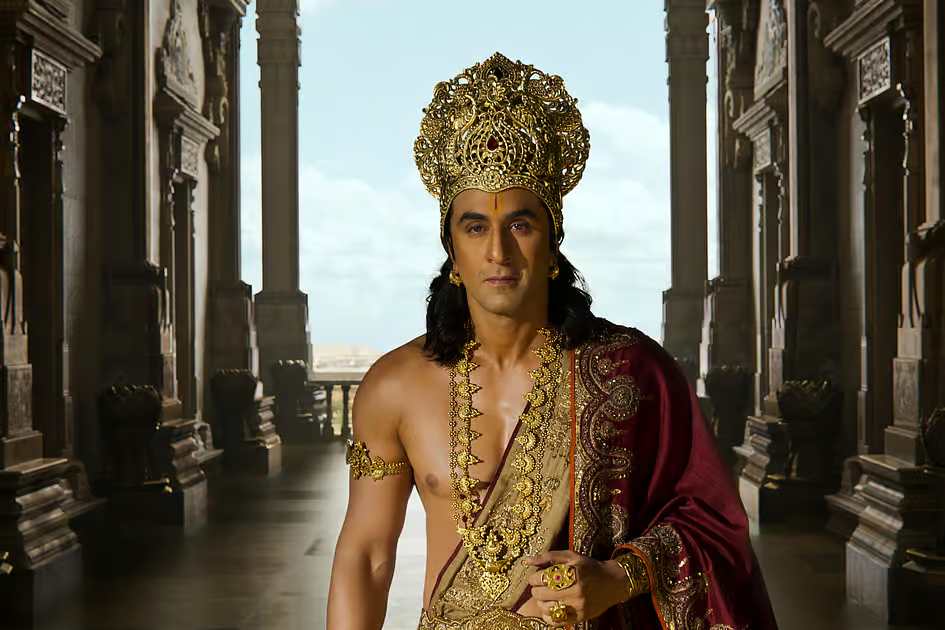
There is a moment in Ramayana: Part 1 when the narrative shifts from the dark, imposing kingdom of Lanka to the sunlit splendour of Ayodhya. The frames become lighter, flowers burst into full bloom and an almost palpable sense of peace takes over. It is a beautiful transition, one that captures what director Nitesh Tiwari’s ambitious retelling of the Indian epic does best. It creates a world of spectacular cinematic beauty, unlike anything Indian audiences have experienced on this scale before.
But as the film progresses, another question comes to the fore. In bringing one of India’s most revered spiritual stories to life through world-class visual effects and filmmaking technology, does some of its emotional and spiritual authenticity get lost along the way?
The answer isn’t entirely straightforward. Because despite some of its shortcomings, Ramayana: Part 1 marks a significant moment for Indian cinema, not least for making a story deeply embedded in India’s cultural consciousness accessible to a much larger international audience.
Stay up to date with the latest news. Follow KT on WhatsApp Channels.
A spectacle of unprecedented scale
Produced by Namit Malhotra and directed by Nitesh Tiwari, the film begins by tracing the origins of Dashanan, or Ravana, against the backdrop of the oppression of the asuras. Introduced in his younger years (powerfully portrayed by Raghav Malhotra), Dashanan’s journey from a devoted son to a ferocious ruler is shaped by his desire to reclaim his people’s lost glory. His extraordinary penance eventually earns him immense powers, setting the stage for his rise as one of the most feared figures across the three worlds.
The story then moves to Lanka, where Yash’s introduction as Ravana is anything but understated. Entering through an elaborate combat sequence, he commands the screen with the authority of a ruler convinced of his own invincibility. But it’s the Tandav sequence that follows which truly captures the scale of Tiwari’s vision. With its arresting imagery and thunderous musical arrangement, it offers an early glimpse of the extraordinary visual spectacle audiences are in for.
Much of the credit goes to DNEG’s visual effects and the background score by Hans Zimmer and A.R. Rahman, which together become the film’s greatest strengths.
The music deserves particular appreciation for knowing when to make its presence felt and, more importantly, when to step aside. Rather than constantly instructing audiences on what to feel, the score allows the emotional weight of the narrative to unfold naturally. It enhances the grandeur without overpowering moments of stillness.
Humanising the divine
One of the most interesting creative decisions Tiwari makes as a storyteller is to resist presenting the narrative as a succession of miracles. Despite its spiritual foundations, Ramayana unfolds largely through recognisable human emotions. There’s love, ambition, jealousy, betrayal and sacrifice, emotions that could just as easily define the dynamics of an ordinary family, albeit one that happens to rule a prosperous kingdom.
But above all, it’s a story about the choices one makes and how their consequences ultimately shape one’s destiny.
The film repeatedly returns to the idea that a person’s destiny is shaped by their nirnay, or decisions, which determine their actions, or karma. And through this philosophical thread, Tiwari explores the idea that destiny is not merely something that happens to us, but something we actively create through the choices we make.
And nowhere is this more powerfully illustrated than in Ram’s exile, where the weight of the injustice hangs heavy, allowing audiences to grasp the enormity of what has transpired.
In the willingness of Ayodhya’s citizens to accompany their beloved prince into exile lies a beautiful reflection of what makes a revered leader. His greatest achievement is not the kingdom he rules, but the loyalty and love he earns from its people.
These are among the film’s most affecting moments, precisely because they don’t depend on elaborate visual effects or grand cinematic spectacle to communicate their significance.
Honest performances, but is the divinity missing?
Ranbir Kapoor is earnest in his portrayal of Ram, bringing a certain gentleness to the character. Yet, one finds it difficult to completely shake off the lingering impression of his portrayal of Ranvijay in Animal, particularly when watching him embody a character so deeply associated with divinity and righteousness.
For generations of Indian viewers, Arun Govil’s portrayal of Lord Ram in Ramanand Sagar’s television adaptation has defined the character. Interestingly, Govil himself appears in this film as King Dasharatha.
Watching him, one is reminded of how effortlessly he communicates divinity through his eyes alone. A quality Kapoor doesn’t quite manage to capture all through out because there remains a subtle distinction between playing a righteous man and portraying someone whose goodness carries an almost divine presence.
Kapoor succeeds more convincingly at the former.
A similar challenge emerges with Sai Pallavi’s Sita. While her performance is sincere, she doesn’t quite embody the ethereal quality traditionally associated with the character. Both actors bring humanity to their roles, but occasionally miss that small yet significant glimpse of divinity that could have made their performances truly stellar.
Yash, meanwhile, makes for an imposing Ravana, particularly in the restrained moments when his grit and arrogance come through.
However, some of the most memorable performances come from the supporting cast. Lara Dutta as Kaikeyi and Sheeba Chaddha as Manthara are particularly impressive, bringing emotional conviction to characters whose decisions fundamentally alter the course of the story.
Ravie Dubey is another standout as Lakshman, bringing warmth and much-needed humour to an otherwise intense narrative without undermining its seriousness.
Vivek Oberoi, too, makes an impression as Vidyutjihva, particularly in an elaborate confrontation with Ravana, who challenges him to draw even a single drop of his blood in exchange for Lanka. And one could only hope to see more of Saurabh Sachdeva working his magic as Mareech.
When spectacle becomes the star
If there’s one area where Ramayana truly breaks new ground, it’s in the sheer scale and sophistication of its visual effects. The film achieves a level of cinematic craftsmanship rarely, if ever, witnessed in Indian cinema, with sequences that can comfortably hold their own against some of the most ambitious productions emerging from Hollywood.
Earlier this year, Christopher Nolan’s The Odyssey brought another ancient epic to the big screen, making the comparison difficult to resist. Both stories inhabit worlds of gods, extraordinary beings and human struggles against seemingly insurmountable forces.
Interestingly, there’s even a striking parallel in their source narratives. During Sita’s swayamvara, Prince Ram lifts Lord Shiva’s divine bow, which breaks as he attempts to string it. Similarly, in Homer’s Odyssey, Odysseus effortlessly strings his legendary bow after all of Penelope’s suitors fail to do so, with the act becoming a defining moment in both epics.
But beyond these narrative parallels, it’s the assertive command over scale that gives Ramayana the heft to hold its own alongside some of the most ambitious cinematic spectacles emerging globally, marking a significant milestone for Indian cinema.
The Pushpak Viman sequence, for instance, deserves a special mention, as does the spectacular confrontation between Ravana and Jatayu.
And considering the disappointment that was Adipurush, the last major big-screen attempt to retell the epic, Ramayana represents a remarkable leap forward in both visual execution and storytelling.
Yet, for all the praise its technical achievements deserve, the film isn’t entirely immune to the excesses of computer-generated imagery.
The forest sequences, in particular, are where the technology begins to work against the storytelling. There’s something about the expanse of a real forest and its textures that can evoke a more emotional response. Here, the digitally created landscapes occasionally lack that authenticity, making it difficult to feel fully immersed in the world the characters inhabit.
The problem becomes more apparent during the extended battle involving Surpanakha’s forces. The sequence feels overstretched and the sheer volume of visual effects begins to distance audiences from the emotional stakes.
Surpanakha, played by Rakul Preet Singh, is also one of the film’s weaker characterisations.
Her humiliation and subsequent actions are crucial to the events leading to Sita’s abduction. Yet, the film doesn’t fully establish the emotional gravity of her experience, making a significant turning point feel less powerful than it should.
The language presents another interesting choice. While contemporary adaptations of ancient epics often simplify dialogue, as seen in Nolan’s The Odyssey, Ramayana retains much of its Sanskrit-influenced vocabulary, lending the film cultural authenticity.
Although some passages can be difficult to follow, the larger narrative remains accessible, even to viewers unfamiliar with the mythology.
A new chapter for Indian cinema
Ultimately, what makes Ramayana: Part 1 significant is not simply the scale on which it tells a familiar story, but its ability to introduce an epic deeply rooted in Indian culture to audiences across the world.
For Indian viewers, Valmiki’s Ramayana is often part of childhood, passed down through family storytelling, television adaptations, religious traditions and cultural memory.
For those encountering it for the first time, however, Tiwari’s film offers an ease of introduction to a world of kings and kingdoms, rivalries and relationships, duty and sacrifice. One doesn’t need extensive knowledge of Hindu mythology to understand the stakes or become invested in the journey. Because by time the film draws to a close, the story has become much more than that of a prince exiled from his kingdom.
In that sense, Part 1 ends at an appropriate point, as a man takes matters into his own hands and sets out to create his destiny, marking, in the truest sense, the beginning of Ram’s journey towards becoming Lord Ram.
The closing stretch regains the momentum lost during some of the extended forest sequences, leaving audiences invested in what comes next. And those who stay through the end credits are also rewarded with a glimpse of Sunny Deol as Hanuman, setting the stage for the next chapter.
Ramayana: Part 1 may not always capture the spiritual depth of the epic it seeks to recreate. But there is no denying the magnitude of what has been achieved.
With an ambitious approach to one of India’s most treasured stories, the film sets a new benchmark for Indian cinematic craftsmanship, while leaving audiences eagerly anticipating how the story will unfold in Part 2.
Source: Khaleej Times