


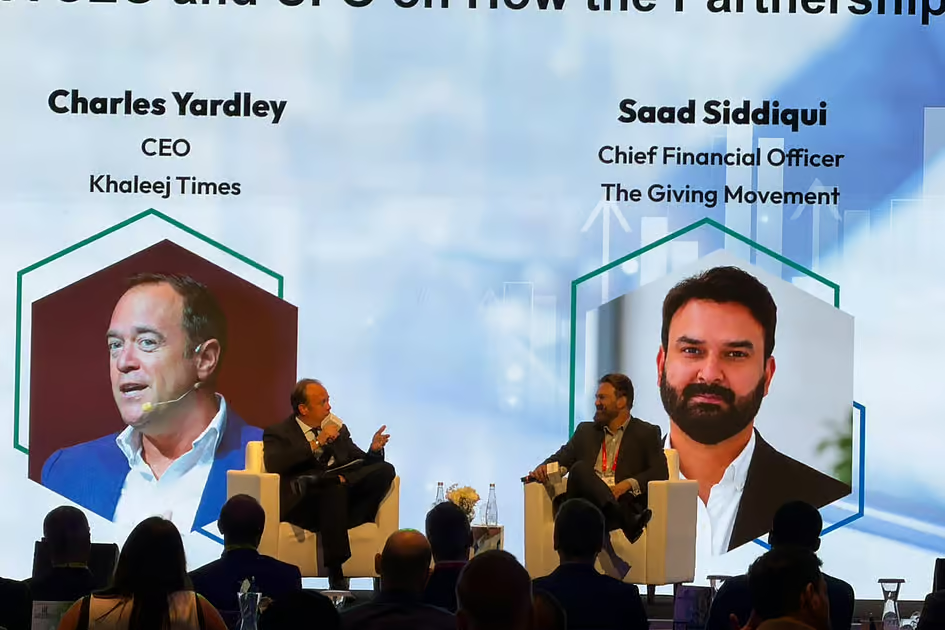
CFOs are increasingly expected to help shape business strategy, understand operations and even bring artificial intelligence into the workplace, moving well beyond their traditional responsibility of managing accounts and financial performance, industry leaders said at the New Age Finance and Accounting Summit (NAFA) Summit Dubai on Wednesday.
The evolving role is also changing the relationship between chief executives and finance chiefs, with the two expected to balance business ambition against financial risks and commercial realities.
Speaking during a session titled ‘In the room together: A CEO and CFO on how the partnership really works’, Saad Siddiqui, CFO of The Giving Movement, said the biggest challenge was often bridging the gap between a CEO’s long-term vision and a CFO’s responsibility to assess whether the business could afford to pursue it.
Stay up to date with the latest news. Follow KT on WhatsApp Channels.
“CEOs come with a different ambition. They want to take the business forward. They see the long-term vision for the business. Then it comes down to CFOs to make it a reality,” he said.
He explained that while both leaders may agree on the direction of a business, they could approach opportunities from very different perspectives.
“Someone is coming purely from an ambitious kind of mindset, and someone coming purely from a risk and commercial kind of lens. How do these numbers make sense? For example, do we have right capital to invest and to make that ambition a reality?”
Siddiqui said not every promising opportunity was necessarily right for a company at a particular stage of its growth, particularly when the financial commitment was substantial.
“There are many good opportunities, but may not be suitable for the business at that stage. For example, the capital commitment may be too big for businesses.”
CFOs moving beyond traditional financial responsibilities
Taking the discussion further, Charles Yardley, CEO of Khaleej Times, asked Siddiqui what CEOs might fundamentally misunderstand about the expectations placed on finance chiefs today.
Responding, Siddiqui said the CFO’s job had evolved considerably, with boards and CEOs expecting finance leaders to contribute to much more than conventional financial management.
“What the boards and CEOs are expecting now from the CFOs was no longer the case before. It was very commercial, conventional kind of a role before, but now we are seeing more and more CFOs taking the kind of position of CEOs as well,” he said.
He added that finance leaders were increasingly embedded across different parts of an organisation, giving them a broader role in decision-making.
“They are not only restricted into the P&Ls or the financials or accounting matters; they are embedded within the organisation. So, most of the time, as previous leaders have said as well…that time is now spent more with the operations, with the business, on a strategy, looking into the bigger picture.”
The role also involves building relationships with external stakeholders, including lenders, bankers and suppliers, Siddiqui said, describing it as an expanding set of responsibilities that is not always reflected in a CFO’s formal job description.
AI adds another dimension to the CFO’s role
The growing influence of technology is adding yet another layer to the expectations placed on finance leaders.
Siddiqui said CFOs were now also expected to develop expertise in artificial intelligence and identify ways to use it to improve business efficiency.
“This is an evolving kind of space, and now I think there was this mention as well that the CFOs are now expected to be an expert in AI as well, you know, to bring in efficiency into the business.”
Yardley, meanwhile, stressed that despite the growing role of AI in finance, CFOs would remain indispensable to businesses, describing them as strategic partner like a ‘co-pilot’ rather than just financial custodians.
“I think CFOs are genuinely indispensable, and that’s because of the judgment, the courage, and I think the ability that they have to see the whole of the business rather than just the balance sheet. That’s the ultimate CFO… that’s the ultimate partner that you’re looking to have.”
Source: Khaleej Times