


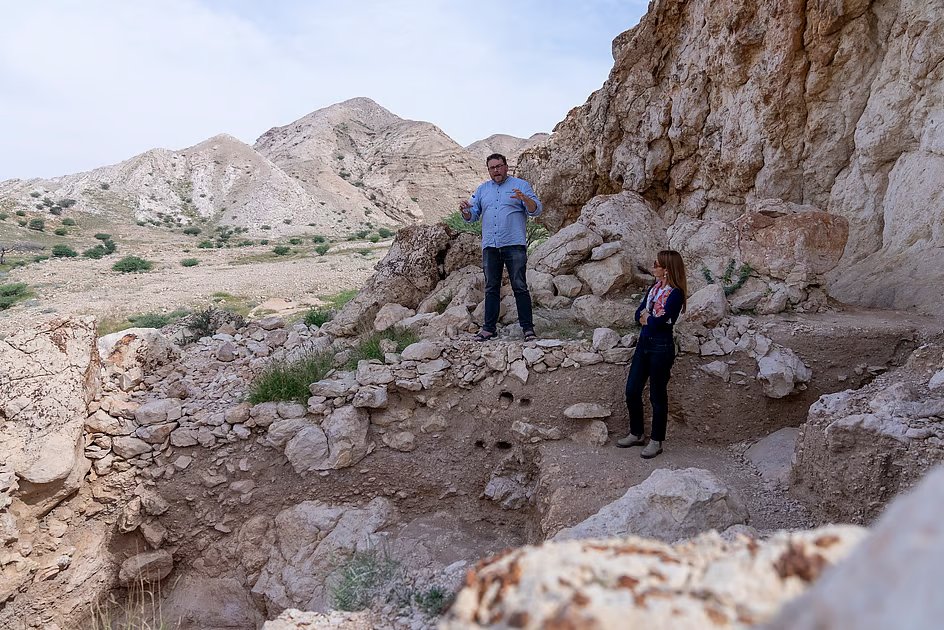
Early humans repeatedly occupied the Buhais Rockshelter over tens of thousands of years, according to a new international study that challenges long-held assumptions about human settlement in southeastern Arabia.
The research, published in Nature Communications, reveals that the region once believed to have been largely uninhabited between 60,000 and 12,000 years ago due to extreme aridity was, in fact, revisited and settled multiple times by early human populations.
Findings from excavations within the Faya Palaeolandscape indicate multiple phases of human presence at the site, dating back approximately 125,000, 59,000, 35,000, and 16,000 years. The latter three phases were previously undocumented, thereby filling key gaps in the region’s archaeological record.
Stay up to date with the latest news. Follow KT on WhatsApp Channels.
The study was led by Eisa Yousif and Sabah Jasim of the Sharjah Archaeology Authority, in collaboration with Knut Bretzke of Friedrich Schiller University Jena and Adrian Parker of Oxford Brookes University, alongside researchers from German universities in Tübingen and Freiburg.
Researchers say the evidence confirms that the rockshelter was not occupied during a single period, but instead served as a recurring site of human activity, highlighting early populations’ ability to adapt to shifting environmental conditions.
Additional palaeo-environmental research indicates that these periods of occupation coincided with phases of increased rainfall and water availability, creating habitable conditions that supported vegetation and human life.
This marks the first clear evidence linking human presence in Arabia between 60,000 and 12,000 years ago to such environmental changes.
Southeastern Arabia has long been considered a key migration corridor for early humans moving into Asia. The new findings suggest that populations not only passed through the region but also returned to and settled in it repeatedly over extended periods.
The Buhais Rockshelter played a crucial role in preserving this history. Its limestone structure protected layers of sediment that accumulated over thousands of years, preserving stone tools and artefacts in a rare, stratified sequence.
These deposits, reaching depths of around 1.7 metres, enabled researchers to reconstruct a detailed timeline using luminescence dating techniques.
Together with nearby sites such as Jebel Faya, the discoveries reinforce the global significance of the Faya Palaeolandscape, which was inscribed as a UNESCO World Heritage Site in 2025.
Commenting on the findings, Eisa Yousif, Director General of the Sharjah Archaeology Authority, said the study represents ‘an important step’ in understanding early human history in the region.
Eisa Yousif, Director General of the Sharjah Archaeology Authority
“The evidence from Buhais demonstrates that southeastern Arabia was not simply a passage for early humans, but a landscape where they returned, adapted, and sustained life across changing environmental conditions,” he said.
The research also highlights long-term collaboration between the Sharjah Archaeology Authority and international institutions, contributing to global understanding of human evolution, migration, and adaptation in arid environments.
Source: Khaleej Times