


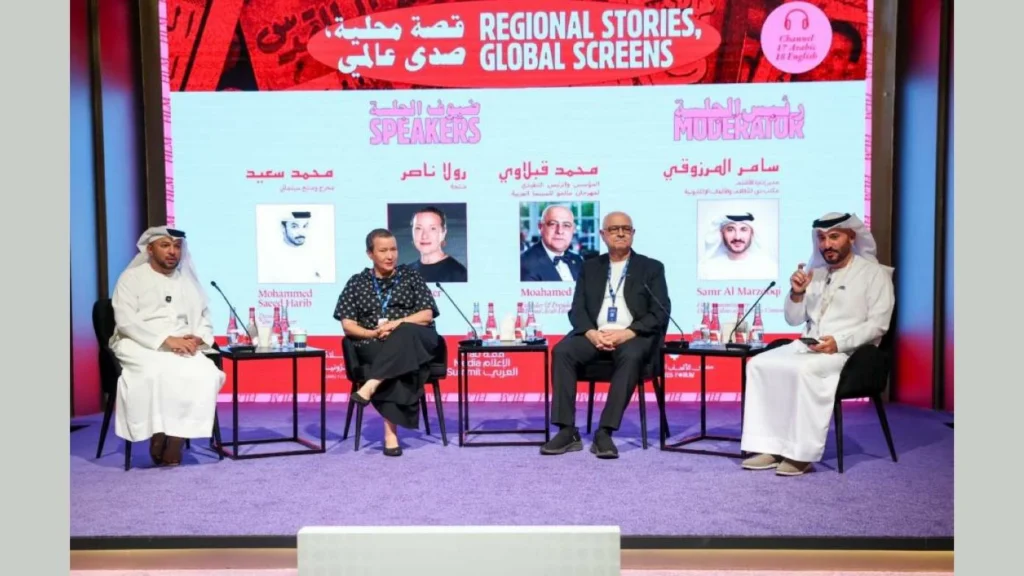
Industry leaders say authentic storytelling, strong production and effective distribution are key to taking Emirati and Arab films to international audiences.
The session “Regional Stories, Global Screens” explored a fundamental question: how to create a story rooted in the identity and cultural specificity of a place, then take it to festivals, markets and international platforms without losing its local character.
The session was held on the second day of the Arab Media Summit 2026 on the Film and Electronic Games Stage as part of the Film and Electronic Games Forum. It featured Mohamed Qiblawi, founder and CEO of the Malmö Arab Film Festival, Mohamed Saeed Hareb, director and film producer, and producer Rawan Nasser.
The discussion focused on the power of storytelling, local identity, and the role of production, distribution and festivals in helping films reach international audiences. It also examined the impact of technology and modern platforms in reshaping the film industry and creating new opportunities for Emirati and Arab talent.
The session presented a view of universality based on the idea that films do not need to abandon the details of their societies in order to resonate beyond their borders. Instead, these details can become a source of distinction when they are transformed into stories with universal human themes and presented through a professional cinematic language.
Mohamed Qiblawi, founder and CEO of the Malmö Arab Film Festival, highlighted the importance of festivals in introducing Arab cinema to a wider international audience. He stressed that the role of festivals extends beyond screening films and forms part of the broader filmmaking ecosystem and a film’s international journey. Festivals bring together directors, producers, distributors and industry professionals, helping to build partnerships, create networking opportunities and open access to new markets.
The session also discussed the importance of establishing a clear path for a film after production is completed. A strong story and high-quality execution alone are not enough to reach audiences. They must be supported by effective distribution, marketing and participation in the right festivals, markets and platforms. The discussion also highlighted the cultural and social diversity of Arab cinema and its rich reservoir of stories capable of reaching global audiences. Developing authentic stories and investing in them artistically and commercially was described as an opportunity to strengthen the Arab presence in international cinema.
Addressing the theme of identity, director and film producer Mohamed Saeed Hareb spoke about the ability of local stories to transcend the environments in which they were created and connect with broader audiences. He stressed that seeking universality does not mean imitating foreign experiences or abandoning local characteristics. Instead, it begins with filmmakers having a clear voice and telling stories they understand and can present convincingly.
The discussion emphasised that global audiences do not necessarily seek stories that mirror their own realities. Rather, they look for stories that allow them to connect with characters and emotions. This creates opportunities for Emirati and Arab stories to gain international recognition when originality is combined with strong execution. The session highlighted themes such as family, belonging, ambition, success, loss and human relationships as subjects that transcend cultures and languages. It noted that honesty in portraying these emotions gives stories the ability to travel beyond their local origins.
On the production side, producer Rawan Nasser discussed the journey of a story from an initial idea to a completed film project. She outlined the requirements of script development, team building, selecting technical elements, overseeing implementation, and planning marketing and distribution strategies. She also highlighted the importance of identifying the most suitable festivals, platforms and markets for a film.
The discussion underlined the producer’s role as a central link in this process. It noted that building a sustainable film industry requires an ecosystem that brings together writers, directors, producers, artistic and technical talent, distributors, platforms and festivals. Such an integrated system can help move films from concept to international competition. The session also stressed the importance of discovering new talent and providing opportunities to develop projects, particularly as a new generation of Emirati and Arab creatives emerges with modern tools and a global outlook.
The discussion was moderated by Samer Al Marzouqi, Director of the Film Department at the Dubai Film & Electronic Games Office. The dialogue covered storytelling, identity, production, distribution, the role of festivals and the opportunities available to local cinema in international markets.
The session also examined the changes technology has brought to the industry. Advances in filming, production and visual effects have expanded creative possibilities, while digital platforms have created new ways to reach audiences. At the same time, these developments have increased competition, as local productions now compete directly with global content on the same platforms.
The session stressed that, regardless of technological advances, technology remains a supporting tool and cannot replace storytelling. Influential films begin with a strong idea, compelling characters and an engaging narrative. Technology then helps translate those elements into a complete visual experience. Concluding the session, speakers said the opportunity for Emirati cinema to reach global audiences begins with confidence in local stories, stronger writing, investment in talent, higher production standards, improved marketing and distribution, and active participation in film festivals.
Source: Emirates 24|7