


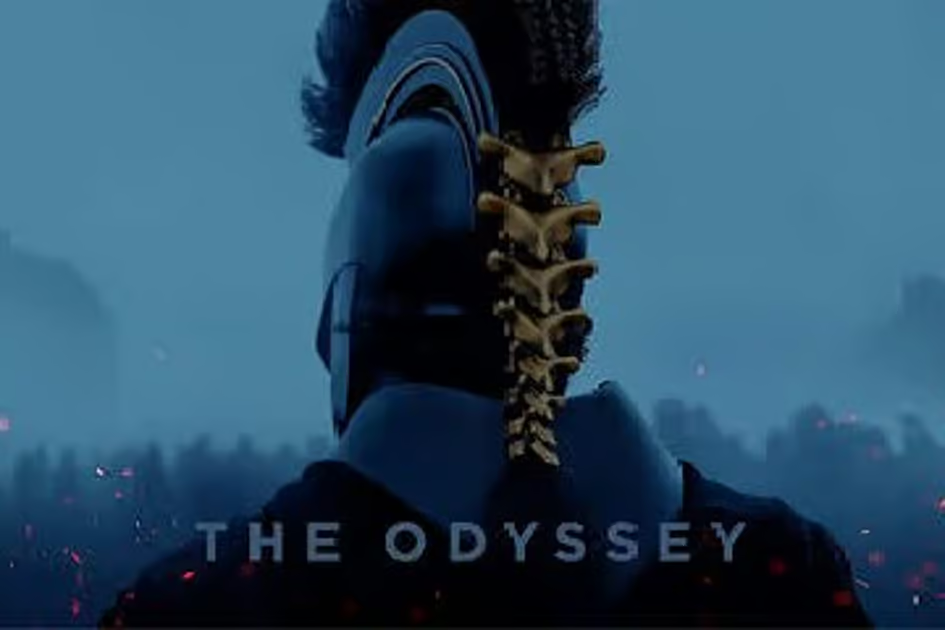
Christopher Nolan has spent more than two decades thinking about making The Odyssey, but the Oscar-winning filmmaker says the project only became possible after years of experience, advances in filmmaking technology, and the unprecedented success of Oppenheimer.
Although Universal’s epic adaptation has become one of the biggest films of 2026, its origins date back to 2004, when Nolan came close to directing Troy, Wolfgang Petersen’s historical epic starring Brad Pitt.
Nolan revealed that the experience never left him.
“I got close to The Odyssey when I was almost chosen to direct 2004’s Troy,” Nolan told the Los Angeles Times. “It stuck with me. It’s a powerful image I really wanted to film.”
The image he was referring to was the legendary Trojan Horse, an idea that remained with him for years before finally finding its place in his own adaptation of Homer’s epic.
While many assumed The Odyssey was a recent project that emerged following Oppenheimer‘s Oscar-winning success, Nolan said it was something he had quietly carried with him for decades rather than actively developing.
Rather than immediately pursuing the project, Nolan went on to make Batman Begins, The Prestige, The Dark Knight, Inception, Interstellar, Dunkirk, Tenet, and Oppenheimer. Only after completing those films did he feel ready to return to Homer.
Nolan said technology also played a decisive role, explaining that for years he believed the scale of The Odyssey demanded filmmaking tools that simply did not exist.
“I’ve been wanting to do an IMAX feature since I was 16,” he told the Los Angeles Times.
He explained that older IMAX cameras were too noisy and cumbersome to capture the intimate performances he wanted.
“I was so struck on Oppenheimer by what IMAX could do for the human face.”
By the time work began on The Odyssey, Nolan had collaborated with IMAX engineers to develop a new generation of cameras that allowed the entire feature to be shot in the format for the first time, while a mirror system helped actors maintain natural eye contact during dialogue scenes.
Producer Emma Thomas said the appeal of The Odyssey goes beyond its reputation as one of history’s greatest epics.
“It’s foundational,” she said when discussing the project, describing the ancient poem as a story that contains adventure, horror, mystery, romance, and family drama.
Nolan agreed. “Emma said it best when we first announced the project. It’s foundational. There’s a bit of everything in it. It truly contains all stories.”
He then argued that Hollywood has rarely given ancient mythology the same cinematic treatment as historical dramas.
“As a filmmaker, you’re looking for gaps in cinematic culture. I’d never seen that done with the sort of weight and credibility that a big Hollywood IMAX production could bring.”
Nolan said the enormous success of Oppenheimer also gave him the freedom to finally make the film.
“One hundred per cent. After Oppenheimer was such a success, far beyond what we hoped for, we had the opportunity to do The Odyssey.”
Despite its scale, Nolan said the film is ultimately about people rather than spectacle.
“I’ve been telling this story in all my films for years. It’s a family story, a love story, a revenge story, a war story, a coming of age story. It’s a very strong foundational text for me.”
Returning to Homer later in life also changed the way he understood the story.
“It reads differently as a middle-aged man. It’s more about love and loss, a middle-aged love story.”
“At times I felt I’d bitten off more than I could chew,” Nolan told The Guardian. “Boy, it was tough. It was tough on everybody.”
While The Odyssey follows Oppenheimer on Nolan’s filmography, the project has been decades in the making. Rather than rushing into Homer’s epic, Nolan waited until he believed he could finally bring it to the screen on his own terms.
Source: Khaleej Times