


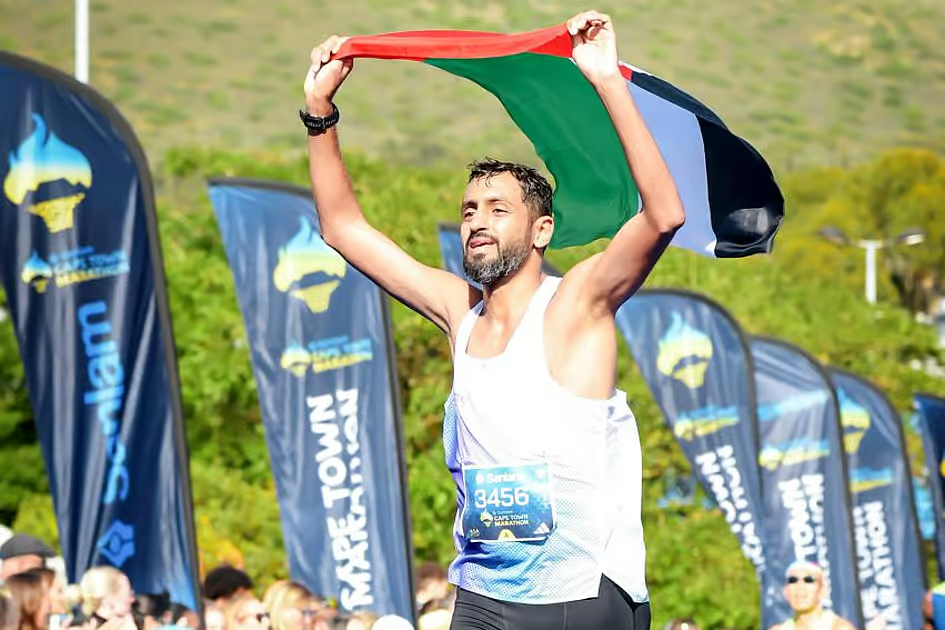
For Salem Al Hashemi, the journey around the world’s biggest marathons began with curiosity rather than ambition.
When his brother persuaded him to enter a 10km race in Abu Dhabi during the Covid-19 pandemic, the civil engineer and former footballer wasn’t even sure he could finish the distance. Today, after years of balancing work, family life and up to 100km of training each week, he has completed every race in the expanded Abbott World Marathon Majors series, taking him from the streets of Abu Dhabi to some of the world’s most iconic marathon courses.
“I just wanted to know if I could run 10 kilometres without stopping,” Al Hashemi told Khaleej Times.
Stay up to date with the latest news. Follow KT on WhatsApp Channels.
At the time, the 34-year-old had spent years playing football and doing CrossFit but had never run farther than the 3.2km fitness test required during national service.
When his brother suggested entering a community 10km race on Yas Island in November 2020, he decided to give it a try.
“I had never run 10km before. I didn’t know if I could finish,” he recalled.
Instead, he crossed the finish line in 41 minutes, placing 10th among around 500 runners and finishing as the second-fastest Emirati.
“I didn’t even know how races worked. I just kept chasing the runner in front of me,” he said. “After that race, my life changed 180 degrees.”
The next day, he bought his first pair of running shoes.
A week later, he lined up for another 10km race and saved more than a minute off his time, finishing in under 40 minutes.
“That’s when I discovered the running community and joined the Abu Dhabi Running Team. From there, it was race after race.”
Since then, Al Hashemi has completed more than 100 local races and over 20 international marathons, lowering his personal best to 2 hours and 48 minutes.
Lessons from falling
His first full marathon remains one of the most memorable.
Running the ADNOC Abu Dhabi Marathon in 2021, Al Hashemi thought the hardest part was behind him as he closed in on the finish line. Then, with just 200 metres to go, both legs cramped, sending him crashing onto the ground.
“It was the first time in my life I had ever experienced a cramp,” he said. “I had played football since I was seven years old and had never felt anything like it.”
He dragged himself to the finish line, determined to complete the race despite the pain.
Rather than discouraging him, the experience became motivation.
His next marathon brought an eerie sense of déjà vu. Again, his legs cramped near the finish, this time around 50 metres from the line.
“I remembered what had happened the year before,” he said. “I told myself, ‘Whatever happens, don’t fall again.’”
He slowed to a walk before crossing the line, relieved that he had stayed on his feet.
Months later, at the Barcelona Marathon, he finally broke the elusive three-hour barrier, finishing in 2:58 – a result that unexpectedly qualified him for some of the world’s biggest marathons, including Boston and Chicago.
Winning the mental battle
While the physical training is demanding, Al Hashemi believes marathon running is ultimately won in the mind.
One of the toughest tests came during the 2023 New York Marathon.
After crossing several bridges, runners reach what participants call the ‘Silent Bridge’: a stretch with no cheering crowds.
“All you can hear is runners breathing,” he recalled.
“You see people stopping, people collapsing and you start asking yourself whether you should continue. That was one of the few times I genuinely thought about withdrawing.”
He pushed on.
Another defining moment came before the 2025 Boston Marathon.
An injury two months earlier had severely disrupted his training, leaving him unsure whether he should even start one of the world’s most demanding races.
Boston’s infamous Heartbreak Hill only added to the challenge.
After crossing the finish line, his oxygen levels dropped below 80 per cent and he was taken to the medical tent. “There was always a battle between what my body was saying and what my mind was saying.”
To prepare for those moments, he deliberately trains his mental resilience during long solo runs. “I spend hours running on my own. That’s when you learn to talk to yourself,” he said. “You keep telling yourself: ‘I can do it.’”
Balancing family and ambition
The achievements have come alongside a full-time career as an engineer and raising five children. Training for a marathon requires around three months of preparation, with six training days each week covering between 90 and 100 kilometres.
“You work eight or nine hours a day, then you need another two or three hours for training,” he said. “It really is a sacrifice. The time that should go to my family, I sometimes have to dedicate to training. Even annual leave has to be planned around race calendars.”
Unlike many elite runners, Al Hashemi funds every aspect of his marathon journey himself. “Everything has been through personal effort: the travel, race entries and equipment. It’s driven purely by passion and love for the sport.”
His engineering background, he says, has also helped shape his approach to running. “Engineering teaches you to solve problems and plan ahead,” he explained. “I plan my year around work, races, family commitments and holidays. If something changes, I find another solution.”
Completing the journey places Al Hashemi among a very small group of marathon runners worldwide. According to Abbott World Marathon Majors, just 2,094 runners had earned the programme’s official Six Star Medal after completing the original six majors by the end of the 2025 New York City Marathon.
Al Hashemi has since gone a step further by completing all eight races that now make up the expanded Abbott World Marathon Majors series.
One of his most memorable moments, he said, was bearing the UAE flag during the Parade of Nations ahead of New York Marathon 2023. “The MC announced my name and country, and spoke about significant monuments in the UAE – it was a very honourable moment for me.”
Last year, Al Hashemi was honoured by Sheikh Nahyan bin Zayed Al Nahyan, chairman of the Abu Dhabi Sports Council, in recognition of completing the Abbott World Marathon Majors. During the ceremony, Sheikh Nahyan praised his achievement and reaffirmed the council’s commitment to supporting Emirati athletes and encouraging excellence in community sport.
“The honour from Sheikh Nahyan meant a great deal to me,” he said. “It showed that our leadership follows these achievements and appreciates the effort athletes put in.”
Despite reaching a milestone many runners only dream of, Al Hashemi says the journey is far from over. “I have more goals,” he said with a smile. “For now, I’ll keep them to myself.
“For me, every finish line is just the beginning of another challenge.”
Source: Khaleej Times