


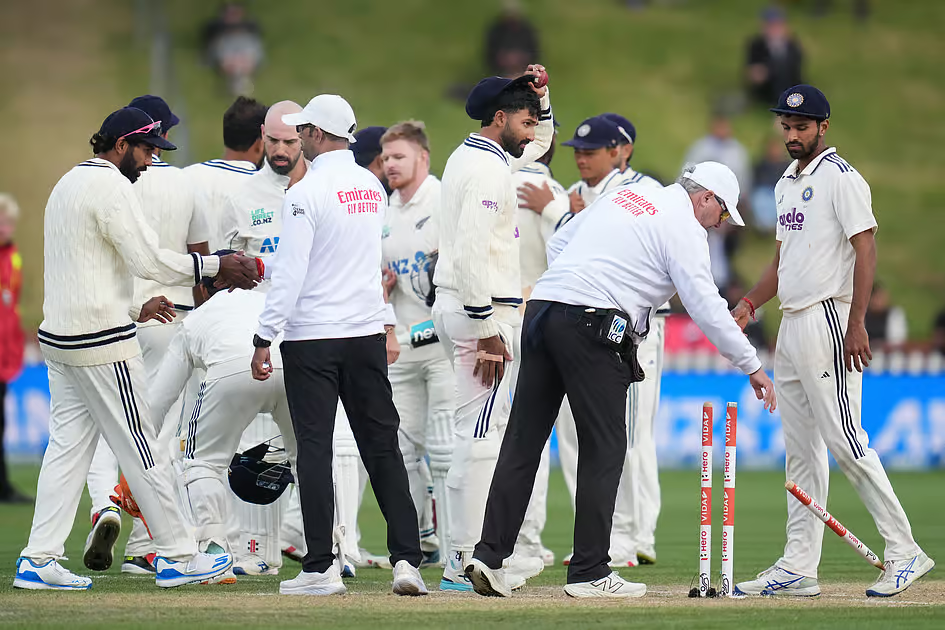
India captain Shubman Gill said Monday he wants the ban on using saliva to shine the cricket ball to be relaxed after a drawn Test against New Zealand played on a lifeless pitch.
Only 24 wickets were taken across five full days of play while 1,327 runs were scored, including a record 720-9 by India, the highest innings in Tests in New Zealand.
A usually fast and bouncy Basin Reserve was low, slow and lifeless by the second morning.
“If you are not shining the ball or if you are not able to maintain the ball, especially on wickets like this, it makes the job of the bowlers very difficult,” Gill said after New Zealand ground out 239-5 in their second innings to rescue a draw.
“I do believe that players, teams should be allowed to use saliva. It was a rule that was made during Covid. I think we are long past that.
“If the ball is going soft after 25, 30 overs or it’s going out of shape, and you are also not able to maintain the ball and use saliva then it’s very difficult.”
New Zealand captain Tom Latham said Gill was right in his assessment of the ball during the match.
“Probably apart from day one, throughout the game the ball tended to get soft,” Latham said.
“But in terms of rules and conditions, certainly from a saliva point of view, I’m not sure that will change (with) what the world’s been through.
“You’ve got to find a way and in the current day and age and the rules that we currently have, we work as hard as we can to keep the ball in as good a condition as possible.”
Both captains said the match ball has seemed softer in recent years and provided a challenge to fielding units to maintain and encourage swing.
In Wellington the issue was exacerbated by a dry wicket that didn’t break up and got progressively slower as the match wore on.
Gill said it was “not a great Test wicket”, while Latham said it was “not your traditional Basin surface”.
New ground staff took over the Basin Reserve pitch during the New Zealand winter, but had their preparation time hampered due to flooding, Cricket Wellington staff told AFP, leading to a lifeless track.
Pace spearhead Jasprit Bumrah claimed four first-innings wickets on his return to Test cricket after a year away, as India bowled New Zealand out for 368.
Their pace attack looked tired in the second innings, however, and New Zealand were 239-5 when the teams shook hands on a draw.
“I guess that’s one that we’ve probably got away with,” Latham told reporters at Basin Reserve.
“Looking at the position we were in on day one, I think the amount of pressure that we were put under to then be in a position where we got 360 or 370… we were certainly pretty happy (with that).
“Heading into the third innings, where there’s only a couple of results at play, I think (it’s great) the way those guys were able to apply themselves and stick to their plans for a long period of time, and ultimately get the draw.”
Latham, whose own contribution to the batting was a pair of ducks after being dismissed by Bumrah in the first over of each innings, said the draw was particularly important for the race to the World Test Championship (WTC) final.
New Zealand were top of the WTC standings at the start of the Test last week only to be overhauled by reigning champions South Africa. Monday’s draw means they will slip down another place to third behind Australia.
India and New Zealand now head to Christchurch for the second and deciding Test starting Friday, where both captains expect a more typical green, grassy and seamer-friendly wicket.
Source: Khaleej Times