


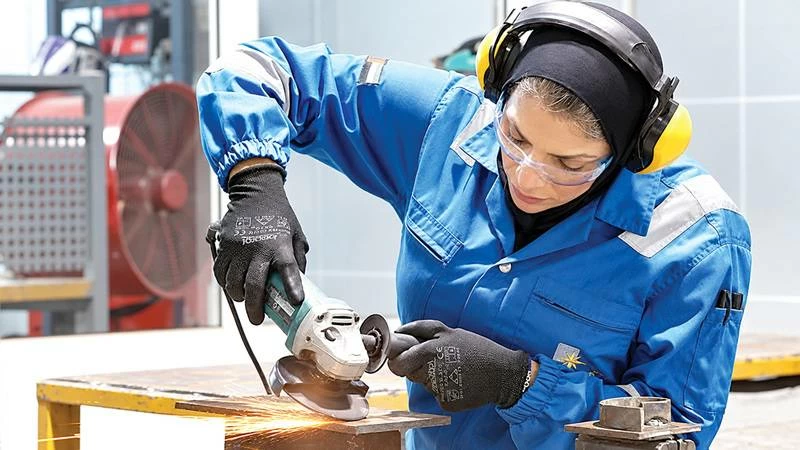
Hajar Al Hosani turned grief, a pandemic and repeated rejection into a welding career, and is now training the next generation of women to follow her into the workshop
Dubai: In a scene where the hardness of iron softens before henna-adorned fingers, Hajar Al Hosani stands with determination, writing her unique story with a hammer and a torch, attracting attention as an Emirati woman confidently entering the world of blacksmithing and welding.
She did not settle for knocking on doors of a field monopolised by men, who refused to teach her the secrets of the profession. She left no industrial area unvisited, overcoming challenges and transforming scrap metal into a space for creativity with flames.
Her journey began from the womb of loss, forging a will from the harshness of circumstances, proving that the daughters of the nation are capable of taming the impossible, armed with passion and unlimited support from a leadership that believes in their abilities in all fields and is keen to celebrate their talents, under the slogan: “Together, we emerge stronger and better.”
At the start of her interview, Hajar emphasised that her entry into this demanding world was not pre-planned, but rather a result of compelling humanitarian circumstances.
She explained: “During my university years, my mother, may God have mercy on her, suffered from illness, which forced me to switch my studies in the last two years of human resources and business administration to an online programme, so I could accompany her on her medical trips. However, after a struggle with the illness, she passed away. Due to my close relationship with her, being the youngest member of the family, I entered a temporary period of depression and inner emptiness after losing my mother.”
She added: “That period coincided with the COVID-19 pandemic, and because of my previous work in the aviation sector, I was keen on watching videos. One day, I happened to see a video about restoring a dilapidated classic car worth no more than $150, and how its buyer had uniquely succeeded in restoring it from scratch and transforming it into a true work of art. At that moment, my curiosity was ignited to research and learn more about the world of blacksmithing and welding, especially since I am passionate about it.”
“It is my nature to be at home, assembling and installing things myself without needing specialised labour,” she added.
Challenges and rejection
Regarding the crucial early challenges that Hajar faced during the beginning of her arduous journey, when she had to put in effort to learn the secrets of the world of blacksmithing and welding, she explained: “I did not know that there were specialised centres in the field in the Emirates, so I went to the industrial area and asked the workers there to teach me [the art of the craft], but they strongly refused and were surprised by my request, while others tried to exclude me for fear of the police and the pitfalls of closing their workshops, under the pretext of preventing women from entering them. Despite the astonishment and the general waves of surprise that appeared on faces at that time, I clung to my goal and did not give up. I took the initiative with one of my friends to search for alternative solutions until we finally found [Lootah Technical Centre], which was founded by Saeed bin Ahmed Al Lootah, may God have mercy on him, in Dubai.”
She continued with a tone of pride and nostalgia: “I remember my first meeting with the trainer and my request to him to give me a simple idea about the methods of blacksmithing and welding iron. I also remember my learning stations at the Centre and my successes thanks to his encouragement, and then passing all the training hours in less than seven months, until the moment of my graduation in a joyous ceremony, with a professional diploma in blacksmithing and welding in my hands.”
Every profession has its own uniform
Regarding the difficulties of the journey, Hajar found that dealing with iron was not just a physical effort, but a societal challenge that she succeeded in shattering, to create a promising new horizon for the women of the Emirates in the future.
She added: “In my early days, some people criticised me and even questioned the blacksmith clothes I wore, so I would simply reply that every profession has its own uniform, just like the uniform of a doctor or a policewoman.”
She continued jokingly: “Because of the many diverse comments I received, I tried to break the rule, so I started applying henna and some nail polish colours, and I continued my daily work in the workshop like any ordinary woman. Professions do not have a specific gender, and the daughters of the Emirates have reached the point of piloting planes and ships, so why shouldn’t they break into all fields, no matter how difficult or complex they are?”
Hajar recalled a touching humanitarian situation that changed the course of her professional experience and solidified her foothold in the field: “One day, I met an elderly man in a shop who had learned about my experience from one of the Ramadan programmes. He greeted me with unprecedented joy and warmth, expressing his pride in my unique experience in the field, considering it not strange for the daughters and women of the Emirates. At that moment, I felt for the first time that I had touched people’s hearts and homes, and I realised the extent of my responsibility in conveying the honourable image of Emirati women.”
Giving and empowerment
After mastering the craft, Hajar moved on to the stage of community giving, describing her journey in the field of training and empowering new generations in the field by saying: “A year and a half after graduation, I started offering free courses dedicated to girls, and I trained in several centres. During this time, I discovered the extent of the creative female talents that the Emirates possesses, and their diverse interests. I knew the extent of the responsibility placed on my shoulders as a trainer, in enabling them to achieve their ambitions in the field. At the same time, I knew the extent of their fear of society’s view, so I encouraged them and reminded them always of the support of our rulers and our country that constantly pushes us to the front lines.”
Hajar emphasised her constant commitment to transferring her skills and passion for metal forming and iron recycling to her students, noting that she executes her work and recycles iron windows with precision, mastery, aesthetics, and functional standards.
She does not consider metal a raw material, but rather a creative space that is renewed each time to transform ideas into achievements that bear her creative imprint. She concluded: “I do not aspire to establish an academy that imposes restrictions and a strict system, but I dream of creating an open workshop that welcomes everyone at any time, because our work depends on art, and the more comfortable a person is, the more capable they are of creativity.”
Industry and inspiration
Hajar addressed a message to the women of her generation, saying: “I hope that every Emirati woman who has a special passion will start to achieve her professional dreams and not wait for the opportunity. We are in a time when there is a great need for handicrafts. If you are afraid of society’s view, take your family with you on this journey and share your passion with them, just as I did, to create your own story that may one day inspire someone else, somewhere else.”
Source: Emirates 24|7