


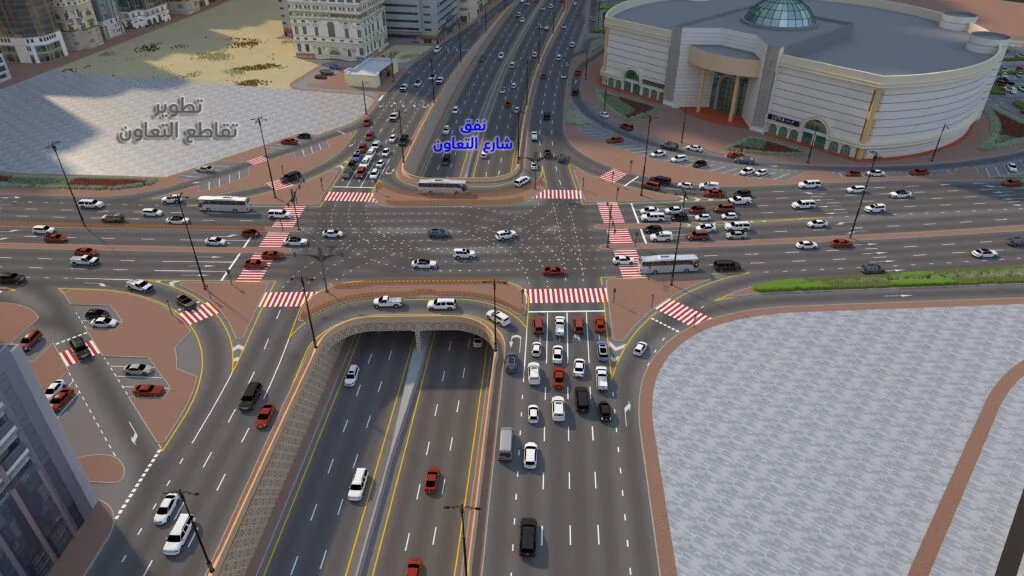
SHARJAH, 17th June, 2026 (WAM) — Sharjah is pushing ahead with one of its most ambitious transport projects to date—a AED750 million programme to build and upgrade road corridors linking the emirate directly with Dubai, with an initial opening planned for November 2026.
The works have been ordered by His Highness Sheikh Dr Sultan bin Mohammed Al Qasimi, Supreme Council Member and Ruler of Sharjah, as part of a broader push to develop the emirate’s road network and improve traffic flow across its various districts.
Leading the delivery are Mubadara (the Authority for Initiatives Implementation) and the Sharjah Roads and Transport Authority (SRTA), working in coordination with the Sharjah Department of Town Planning and Survey, Sharjah Police General Command, Sharjah City Municipality, the Sharjah Electricity, Water and Gas Authority (SEWA), e& (Etisalat), and du.
The project centres on two key axes: a comprehensive upgrade of the Al Taawun corridor running to Al Nahda Bridge and on into Dubai and the development of Al Khan Street through to Sheikh Mohammed bin Zayed Road. Together, they are designed to connect the heart of the old city—the Lakes and Al Taawun districts—with the newer urban corridor stretching along Sheikh Mohammed bin Zayed Road while simultaneously strengthening six crossing points in Dubai.
The scheme is structured with five components being built in parallel. A soft opening of the full project is targeted for November 2026, with precast concrete techniques among the methods being employed to keep pace with the schedule. Traffic diversions coordinated with Sharjah Police have already been put in place and will later feed into the wider road improvement works.
The centrepiece is a 500-metre tunnel running beneath Al Taawun Roundabout, carrying three lanes in each direction from Al Taawun Street towards Al Nahda Bridge and Dubai. A new signalised junction has been designed alongside it, with the capacity to handle around 4,200 vehicles per direction during peak hours.
Beyond its traffic function, the tunnel is intended to give motorists a direct, uninterrupted route to Expo Centre Sharjah and is conceived as the first element of a larger network that will eventually tie in with Noor Road — an extension of Al Orooba Street linking through to the late Sheikh Khalid bin Sultan Al Qasimi Mosque and on to the Heart of Sharjah.
The second component upgrades the Al Khulafa-Al Rashideen Intersection by adding box culverts beneath the existing bridge and two extra lanes in each direction—covering a 37-metre stretch per direction—to keep traffic heading to and from Dubai moving without mixing. A 315-metre slip bridge will provide a fast, direct link to Gamal Abdel Nasser Street, and a new free-flow entry has been added from Al Ittihad Road to Al Khan Street.
The design has taken particular care to avoid blocking shopfront visibility on either side of the road. The upgrade is expected to add capacity for around 2,600 vehicles per hour across both directions.
Two new 130-metre bridges are being built across Industrial Street 1 and Industrial Street 2, each with two lanes per direction and supported by approach ramps totalling around 200 metres on both sides. Free-flow turns will ease movement for traffic arriving from Dubai heading towards Maleha Road, Sheikh Khalifa bin Zayed Road, and Al Waset Road. Peak-hour capacity on the two bridges is projected at around 2,800 vehicles per direction.
The fourth component adds new bridges at Industrial Street 3 to connect industrial areas with the Ring Road and link Sheikh Mohammed bin Zayed Road back through Al Khan Street to Al Ittihad Road. Two new bridges are included, along with turning lanes towards Maleha Road, Sheikh Khalifa Road, and Al Dhaid Road, with combined route lengths of roughly 2.7 kilometres. A culvert will tie Industrial Street 3 to Ring Road. Total capacity across both directions is expected to reach around 5,200 vehicles per hour.
The fifth component upgrades the existing interchange on Sheikh Mohammed bin Zayed Road to increase its overall efficiency and provide faster access between the highway and the Al Taawun, Al Khan, and Al Buhaira areas—easing pressure on Al Ittihad Road and key junctions in the process.
When complete, the network of five bridges, one main tunnel, and a series of free-flow intersections will connect Al Taawun, Al Khan, and Al Buhaira directly to both local roads and federal highways. Daily commuters between Sharjah and Dubai—particularly those travelling through the densely populated Al Majaz and Al Nahda districts—can expect fewer stops and shorter journey times.
The scheme will also benefit visitors to the Expo Centre Sharjah and the Sharjah International Book Fair and improve access to the late Sheikh Khalid bin Sultan Al Qasimi Mosque in the Mamzar area. The overall road network will carry greater capacity to absorb the emirate’s continued population and urban growth.
Source: Emirates News Agency