


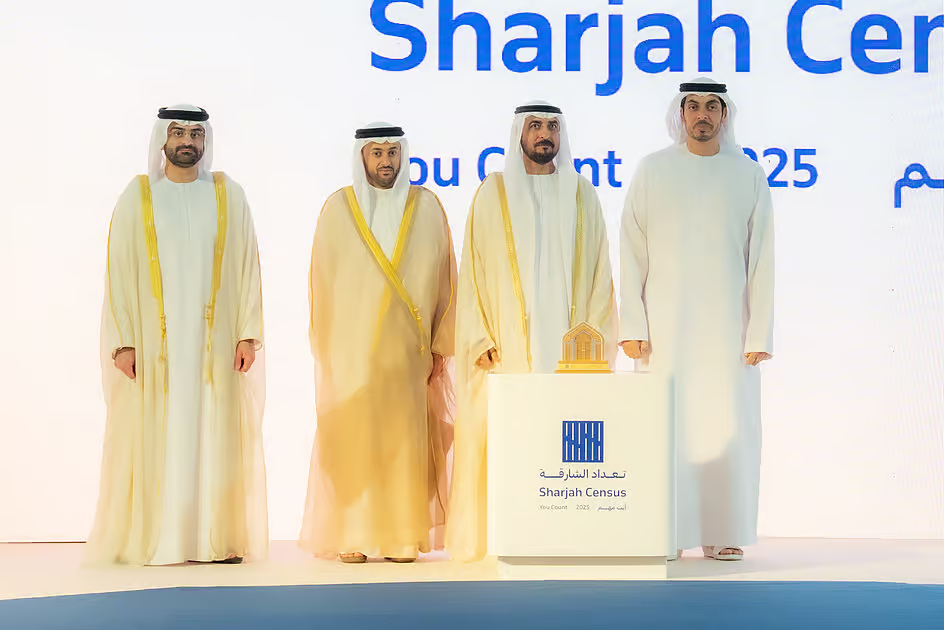
Sharjah’s population has risen to 2.13 million, recording a 51 per cent increase over the past decade, according to the results of the Sharjah Census 2025 announced on Wednesday.
The emirate’s population now stands at 2,135,888, with males accounting for 67 per cent and females 33 per cent. Non-UAE citizens make up 89 per cent of the population, while Emiratis account for 11 per cent, the census showed.
The results were announced during a ceremony held by the Department of Statistics and Community Development at Al Jawaher Reception and Convention Centre, in the presence of Sheikh Mohammed bin Saud Al Qasimi, Chairman of the Sharjah Finance Department.
Sheikh Mohammed bin Humaid Al Qasimi, Chairman of the Department of Statistics and Community Development, said the census was central to planning for the emirate’s future and improving quality of life.
“The value of data is not measured by its size but by its ability to answer future questions before they arise,” he said. “Accurate data gives the decision-maker insight, not just information, and gives society confidence, not just numbers. Our mission is to turn every statistical indicator into a tool that serves human beings, anticipates their needs, and improves their quality of life.”
He added that Sharjah was moving from traditional statistics to an integrated smart system that brings together government records, artificial intelligence and advanced analysis to anticipate future needs.
“This is the direction on which we base our ambition towards 2030, and it is an orientation that makes data a sustainable national wealth and knowledge a real capital for development,” he said.
According to the census, the number of Emiratis in Sharjah reached 234,431, representing 11 per cent of the emirate’s total population. Emirati women slightly outnumbered men, with 118,213 females, or 50.4 per cent, compared with 116,128 males, or 49.6 per cent. The Emirati population grew by 33.6 per cent between 2015 and 2025.
Sharjah city accounted for the largest share of the emirate’s population, with 1,899,202 residents. It was followed by Khorfakkan with 61,936, Kalba with 59,401, Al Dhaid with 39,295, Al Hamriyah with 22,354, Al Madam with 21,230, Dibba Al Hisn with 16,116, Al Bataeh with 9,077, and Mleiha with 7,178.
Among Emiratis, Sharjah city also recorded the highest population, with 134,933 citizens, accounting for 58 per cent of the Emirati population in the emirate. Kalba had 34,278 Emirati residents, followed by Khorfakkan with 28,628, Al Dhaid with 10,915, and Dibba Al Hisn with 9,848.
On education, the census found that 64 per cent of Emirati citizens were enrolled in government educational institutions, while 36 per cent were enrolled in private institutions.
Social and employment indicators showed that 67 per cent of Emirati senior citizens use technology, while illiteracy rates among Emiratis declined by 18 per cent. The proportion of Emiratis employed in the private sector rose by 178 per cent, according to the census.
Sustainability indicators showed that 18.6 per cent of residential units used alternative energy sources, while 71.3 per cent of homes were equipped with safety and security systems. The census also found that 69.7 per cent of villas had landscaped or planted areas.
Source: Khaleej Times