


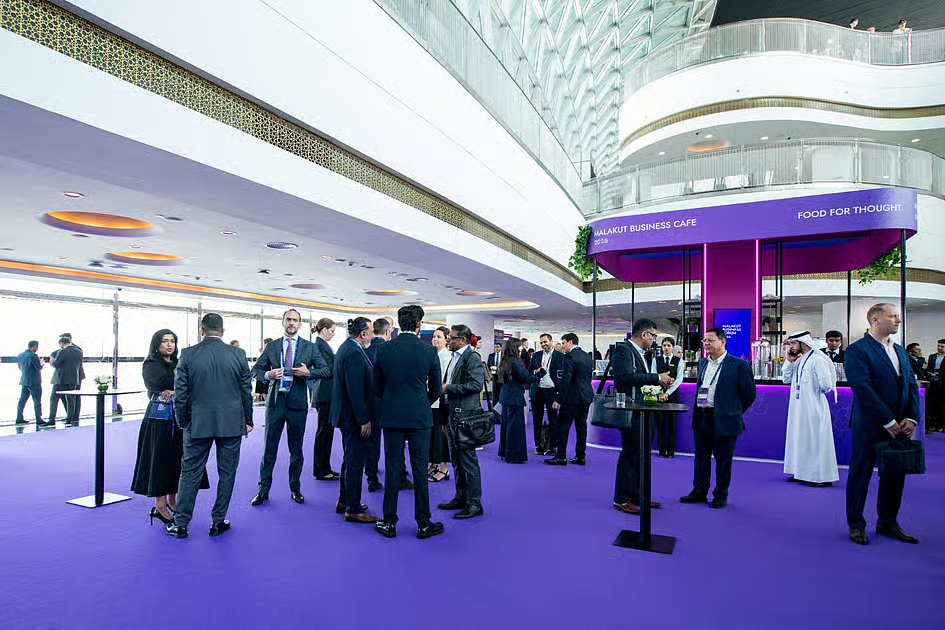
Regional instability, supply-chain disruption and the rapid rise of artificial intelligence are reshaping how UAE businesses plan for growth, according to Alex Dolgopolov, CEO of Malakut and founding partner of Malakut Business Forum 2026.
While geopolitical tensions continue to create uncertainty across global markets, companies operating in the UAE are increasingly focused on adapting to disruption rather than delaying expansion plans.
“The challenges are multiple, and it’s impossible to ignore the regional instability,” Dolgopolov said. “The biggest effect has been the closure of the strait, which has created massive logistical challenges for companies to overcome. Sourcing alternative solutions for logistics, for funding shipments and for insuring them is something we can address through this forum.”
His comments reflect wider concerns among business leaders across sectors ranging from trade and logistics to finance and manufacturing, many of whom gathered at the Malakut Business Forum in Dubai to discuss how companies can navigate a more volatile operating environment. The forum’s agenda focused on financing growth, managing risk, moving goods and applying technology when conditions change.
Yet despite the uncertainty, Dolgopolov argues that the UAE remains one of the region’s strongest-performing markets.
“The numbers are hard to ignore. The UAE is one of the few markets in the region showing very good growth despite everything,” he said. “That’s a result of the extraordinary political and economic measures our government has taken to support businesses.”
He described the country’s performance during a challenging period as “a small miracle”, noting that relatively few sectors have failed to return to pre-crisis levels.
Alongside resilience, artificial intelligence is rapidly becoming a priority for businesses looking to improve efficiency and competitiveness. However, Dolgopolov believes the conversation is moving beyond hype.
“On AI, you hear about it from everyone now, and it’s a buzzword,” he said. “We’re focused on practical applications: CEOs sharing which large language model, which agent or which solution helped them solve a specific problem.”
The emphasis on real-world use cases mirrors a broader trend among UAE companies, many of which are experimenting with AI tools to automate processes, improve decision-making and increase productivity. According to Dolgopolov, the country is well positioned to lead adoption.
“We’re not at the AGI level yet, but the UAE has a huge density of human capital. At this scale of economy, I personally feel we’re on the frontier of adoption as a market.”
Another business trend emerging from the current economic environment is a more pragmatic approach to sustainability. Rather than treating sustainability as a standalone objective, many companies are linking it directly to efficiency and resource management.
“This crisis has made many people rethink it, including reusing stock and inventory,” Dolgopolov said. “A small example: all the builds we made for this conference will be reused next year.”
Despite ongoing geopolitical and commercial challenges, Dolgopolov remains optimistic about the UAE’s economic trajectory.
“The central bank and World Bank forecasts are positive too, and the future looks bright,” he said. “I can’t praise the government enough for creating an environment that keeps this place investable and growing on all fronts.”
For UAE businesses, the message is increasingly clear: resilience, technology adoption and operational flexibility are becoming essential tools for navigating an uncertain global landscape while continuing to pursue growth opportunities.
Source: Khaleej Times