


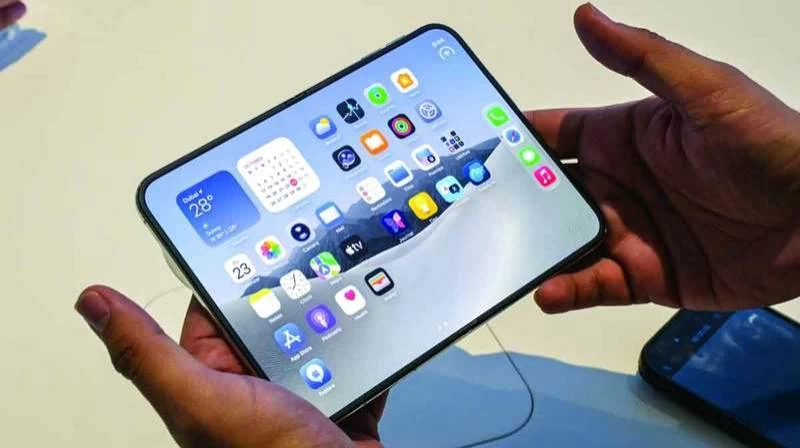
Dubai: The absence of facial recognition technology in the foldable iPhone Duo, which Apple recently launched, has raised questions and concerns among users about the phone’s compatibility with banking applications, digital identity services, and other applications that rely on biometric verification methods to log into accounts or carry out financial and governmental transactions.
Dealers explained that the absence of facial recognition technology prompted them to reconsider their decision to buy the phone and postpone acquiring it, fearing problems in running apps that rely on this technology.
On the other hand, technology experts stated that the absence of a facial recognition sensor in the foldable phone does not mean that biometric authentication and verification processes cannot be carried out, as the front camera can be used to verify the face, while some applications may require updates to keep up with the changes in the authentication mechanism.
In detail, customer Mohammed Yousef said that he experienced initial confusion with the new iPhone Duo, particularly with the absence of facial recognition, which he used to register and log into various apps on his previous phone. He pointed out that he suffered difficulties in the beginning, in knowing how to deal with this problem, before he updated the login processes for apps, using the front camera as an alternative to facial recognition in applications that require biometric authentication. He also had to rely on fingerprint recognition to log into applications.
Trader Tamer Qassem, said that he “was apprehensive about buying the new foldable iPhone after learning of the absence of facial recognition, unlike previous versions of iPhones, which may affect the phone’s compatibility with banking applications, digital identity services, and applications that rely on biometric verification methods to log into accounts or carry out financial and governmental transactions.”
Customer Ashraf Naji explained that he “decided to postpone the purchase of the new foldable iPhone after confirming the absence of facial recognition, as I feared that acquiring the phone would affect my ability to continue using digital services with the same ease as previous versions of iPhones. Or because they removed facial recognition, I may have to go through additional means to verify identity and complete transactions.”
For his part, technology and digital security expert Dr. Mohamed El-Feky, said that “the absence of facial recognition in the new iPhone Duo phones recently released by Apple will not affect the operation of applications that rely on biometric authentication or verification, whether they are banking or governmental apps.”
He added that “authentication and biometric facial recognition can be performed using the front camera,” noting that users of previous iPhone versions, when switching to the new phone, may need to update apps to be compatible with the new authentication mechanisms.
He explained that “applications previously relied on permission using the built-in facial recognition in iPhone versions, without the need to take a new picture of the face. In new versions, however, it may require updating the authentication mechanism, so that it uses the front camera to verify the face, instead of relying on permission using the facial recognition sensor, as was the case in previous phones.”
For his part, technology expert Ahmed Al Zarouni stated that “the absence of facial recognition in the new iPhone Duo phones will require users to use the front camera to perform biometric authentication and verification processes, with applications being updated to keep pace with the new verification mechanism.”
He added that “the front camera can play a role in facial verification, in addition to the fingerprint available in the new phones,” noting that some applications may need updates to keep up with the changes, after having relied on the facial recognition sensor built into previous iPhone versions.
For his part, tech expert Jess Kim explained that “there’s a difference between logging in and identity verification. Logging in doesn’t necessarily require facial recognition, while identity verification can be done using the front camera instead of a facial recognition sensor.” He added that “updating apps might require using the front camera for facial recognition, rather than relying on facial recognition, which would allow the apps to continue functioning.”
Source: Emirates 24|7