


A global technology company enters the Middle East with an ambitious expansion strategy, a competitive product and an experienced international public affairs consultancy. Having successfully navigated complex regulatory environments in Europe, the US and Asia, its leadership assumes that entering the Middle East will require only a few local adjustments, strategic introductions and the right external advisers.
Then the business encounters an unexpected challenge. A product cannot launch as planned, a regulatory requirement calls into question an established commercial practice, or an expansion strategy that worked in one market proves unsuitable for another. The company responds by commissioning additional legal advice, engaging another consultancy or seeking meetings with senior government officials, when the underlying issue may simply be that the market requires a deeper understanding before key decisions are made.
This scenario illustrates an increasingly important challenge for multinational companies operating in the Middle East. As the region accelerates its economic diversification and technological transformation, corporate advocacy has become considerably more sophisticated than the traditional perception of lobbying as an exercise in access, relationships and regulatory intervention.
Yet many international businesses continue to approach the region with advocacy models developed elsewhere, often underestimating the differences between individual markets and overlooking the strategic role that government affairs can play in shaping business decisions.
One region, fundamentally different markets
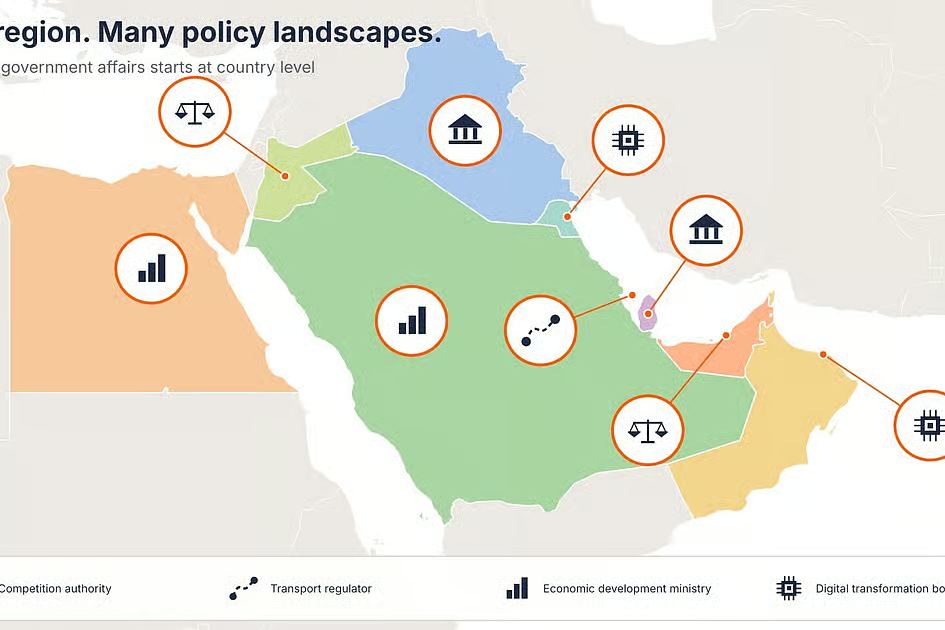
One of the most persistent misconceptions among multinational companies is that the Middle East, or even the GCC, can be approached through a largely unified government affairs strategy. While the countries share important economic, cultural and geopolitical connections, their national development priorities, regulatory institutions and approaches to private-sector engagement are far from identical.
A technology company expanding from the UAE into Saudi Arabia, for example, may discover that a proposition built around efficiency and consumer convenience needs to be reconsidered in the context of Saudi Arabia’s industrial development, localisation and investment priorities. A strategy developed for Qatar cannot simply be replicated in Kuwait, while the economic realities and institutional landscape of Egypt introduce an entirely different set of considerations.
The underlying technology may be identical, but its economic relevance, regulatory implications and contribution to national priorities can vary considerably.
This is why geopolitical analysis alone is not enough. Understanding the region’s broader political and economic relationships is valuable, but businesses must also understand the specific priorities of individual institutions, whether a competition authority, a transport regulator, a ministry responsible for economic development or an organisation advancing digital transformation.
How businesses can engage with governments
For multinational companies, understanding these priorities is only the first step. Regulatory developments can have implications far beyond compliance, influencing product development, investment priorities and the commercial viability of emerging business models.
Saudi Arabia’s Istitlaa platform provides one example of how companies can participate in regulatory discussions. The platform allows private-sector stakeholders to review and comment on proposed legislation and regulations before they are approved.
The UAE provides another illustration of how corporate advocacy can support businesses operating in a fast-changing regulatory environment, where the development of new governance frameworks is increasingly taking place alongside the commercial adoption of emerging technologies.
Artificial intelligence is a particularly relevant example. Building on its national AI strategy, the UAE introduced its Charter for the Development and Use of Artificial Intelligence in 2024, establishing principles covering responsible innovation, privacy, data security and accountability. Although the charter is a policy framework rather than a standalone binding AI law, it reflects the country’s efforts to establish expectations for responsible technology development while encouraging investment and innovation.
The evolution is equally visible in autonomous mobility. Dubai introduced legislation governing autonomous vehicles in 2023, followed by detailed implementing requirements in 2025 and further provisions in 2026 establishing operational phases, safety requirements and the transition towards driverless operations. For technology companies developing autonomous transport solutions, these frameworks have direct implications for how products are tested, deployed and scaled.
Meanwhile, the Telecommunications and Digital Government Regulatory Authority has established an ICT regulatory sandbox to enable companies to test emerging technologies within a supervised environment, allowing regulators and industry participants to gather evidence on how existing rules may need to evolve.
In July 2026, the authority also opened a public consultation on a proposed framework for private mobile networks, inviting feedback from operators, enterprises and other stakeholders.
Together, these developments illustrate how quickly the regulatory environment is evolving alongside technological innovation, creating opportunities for businesses to contribute technical expertise and practical experience while the frameworks governing their industries are still taking shape.
From regulatory compliance to strategic involvement
This is where early engagement can add real value. When government affairs teams are involved while policies and business strategies are still being developed, they can bring relevant technical knowledge to the discussion, identify practical implementation questions and help ensure that commercial plans are informed by the direction of the market.
A senior public affairs executive should be capable of interpreting a national economic strategy, understanding its implications for a company’s business model and identifying opportunities where commercial innovation can support public policy objectives.
Equally, that executive should have the authority and credibility to challenge internal decisions when a proposed commercial practice risks creating regulatory concerns or undermining relationships with consumers, business partners or government institutions.
This requires public affairs to have a meaningful place in corporate strategy, with access to leadership discussions on market entry, commercial planning, product development and investment, rather than operating as a support function activated after decisions have already been made.
The distinction becomes particularly important when companies treat government affairs as a regional service delivered through occasional market visits and a network of local intermediaries. Regional coordination certainly has value, but effective advocacy requires country-level expertise, institutional understanding and a clear appreciation of the practical challenges facing each market.
For multinational businesses, developing these capabilities should be considered an investment in long-term competitiveness rather than simply a cost of regulatory compliance. The value of the function lies as much in the quality of the decisions it helps shape internally as in the outcomes of its external engagement.
Perhaps the most valuable government affairs professional is not the one who can resolve a regulatory crisis, but the one whose understanding of the market helps the business make better decisions from the outset.
The question is not whether a company has relationships across the region, but whether it understands what each government is trying to achieve and where its business can make a meaningful contribution.
– May Youssef is Senior Director – Corporate Affairs at talabat.
Source: Khaleej Times