


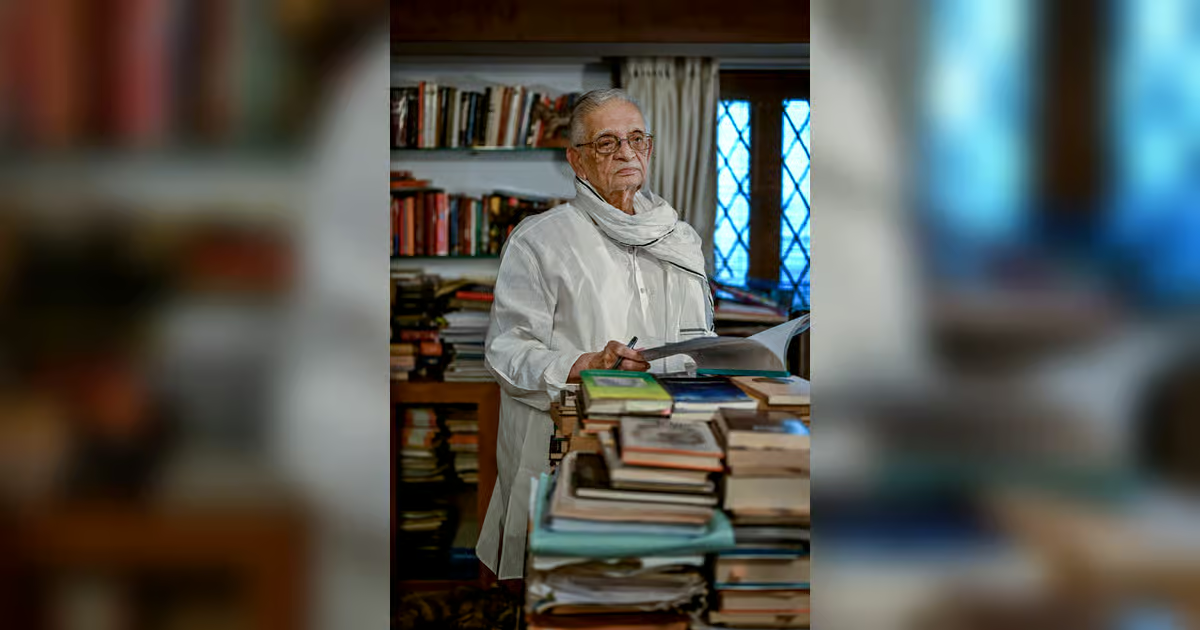
In one of the most beloved songs written by the Indian poet known as Gulzar, two lovers conspire to capture time, to steal it away for themselves.
The voices that render his words in the Bollywood musical inspired by Shakespeare’s Othello are melancholic, playful. But the song, O Saathi Re, has an urgency: the lovers’ plan involves entrapping the tired sun on a day’s end before it slips down into a river.
You hold it there, I will throw in the net
You carry it on your back, I will lend a hand.
Over his six decades in Mumbai, the seaside metropolis where he found shelter as a teenage refugee, Gulzar has had an outsize hand in shaping the idea of tender romance in India.
He has put his imagination to children’s books, short stories and volumes of poetry that have only grown in ambition. Through it all, he has maintained a wonder at the beauty in the mundane.
In late June, I went to see him at his home. As I waited in his driveway to be let in, the steady thumping of the monsoon showers was the only thing that disturbed the quiet in his sloped lane.
“The whole city is wet; isn’t that a very interesting feeling?” he asked me, with a joyful grin. “I think it’s very interesting — something falling from above your head in the clouds. They’re playing with you.”
Gulzar’s poetic outlook made his mark on India’s popular film industry. And Bollywood gave him a livelihood, and the visual and musical wings to travel across the divides of a region of nearly two billion people.
In addition to directing over a dozen films of his own and writing the screenplays for many others, he has provided lyrics to more than 150 Bollywood musicals. You could be singing any evergreen song of the past few decades in India, and chances are strong that the words carrying you away are Gulzar’s.
At 92 now, he is still up with the sun and at his desk every morning, tucked away on the ground floor of his two-storey home.
“The sky opens up, like a roll of fabric,” he said. “Nothing like seeing a sunrise.”
He maintains the kind of discipline that has allowed him to produce a body of work — and the major awards that followed — too enormous to tally.
For one of his recent projects, he collected contemporary poetry from nearly 300 poets writing in three dozen languages from across India — making it all accessible to a wider audience through renditions in Hindi and English. A Poem a Day, as the tome published by HarperCollins is titled, took a decade of meticulous work. It was his promise to a group of students who had complained to him that poetry, relegated to textbooks, was no longer relevant to their daily lives.
We spoke during our visit about his latest book, which is an ode to Mumbai; about his childhood; and about the changing nature of storytelling in Indian cinema in the age of reel-attention-spans. His eyes lit up when he talked about tennis, which he played nearly every morning until two years ago, when he was about to turn 90.
“You know, Federer’s backhand,” he said, “that swing of his backhand, single-handed, was fascinating. Nobody has reached that.”
In my six years reporting in India, two themes have consumed me. In meeting the increasingly few remaining survivors of the bloody 1947 partition that birthed this modern state, I have been moved by their quiet endurance in the face of deep trauma. I have equally been fascinated by the country’s arts and cinema, in how they conjure the idea of nationhood and shared culture across a vastly diverse nation.
Gulzar’s life and Gulzar’s art brought the two together. As my time in India was concluding, I wanted to hear his reflections on both.
A survivor of that gruesome period of bloodletting at the partition of India that created Pakistan, he has drawn on influences and languages from across India, refining and reinventing his art decade after decade to build a body of work known for its tenderness.
All along, he has maintained a certain childlike joy in the world around him, his crisp wit a central part of his art.
Rakhshanda Jalil, who translated several of Gulzar’s books into English, was on a flight to Canada with the poet around 2019. Jalil was busy working on her laptop next to Gulzar, who was in the window seat.
“The sheep, the sheep,” Gulzar repeated to himself, loud enough that she could hear. “They are fighting among each other.”
Jalil said she looked up, confused.
“Don’t these clouds look like sheep that are getting entangled among themselves?”
That same simple wonder at the everyday characterises his poetry and the iconic lyrics he has added to Indian music decade after decade.
There is the hit breakup song Mera Kuchh Samaan, hauntingly simple, about a lover asking for the return of her few remaining items. Song after song that you find on Indian dance floors — from the rhythmic, train-top Chaiyya Chaiyya that has become a timeless anthem of sorts, to the upbeat Jai Ho that has many, arms spread, roaring to the skies. And, of course, the cheeky Dil To Bachcha Hai Ji, about an ageing lover who insists that he is afraid to sleep alone because his “heart is still a child”.
Gulzar was born Sampooran Singh Kalra, to a Sikh family in the village of Dina, in what lies in Pakistan today. There is confusion about his exact year of birth, but he thinks it was 1934. His mother died when he was months old, and he grew up in a household of seven half-siblings.
His father ran a fabric shop in the village and had opened another in Delhi, about 400 miles away. While the rest of the family stayed in the village, he took the child with him to Delhi in the 1940s, where he attended school and helped in the shop.
In the evenings, the boy retreated to the shop’s storeroom, where he would sleep, but only after devouring Urdu detective novels by the lantern light. The stall across the street that he would rent the books from became his earliest literary influence, introducing him to writings from across India and around the world translated into Urdu.
His life changed when the owner one day recommended an Urdu translation of The Gardener, a collection of poems by Rabindranath Tagore, India’s first Nobel laureate. He read and reread the book, renting it repeatedly until it became the first book he ever stole.
But poetry was also something that was slowly drilled into him at the Delhi school he attended, the United Christian School. His literature teacher, a Muslim cleric, encouraged students to memorise couplets. Gulzar described the process as akin to imbibing religious texts.
“The couplets that you memorise,” he said, “when its meaning starts getting into you, that is how the learning comes into you, that is how education comes in.”
As one of his methods, his teacher would split the class in half for a Bait-Baazi, a competition of couplets. A member of each team had to think of a couplet starting with the letter that the previous team had ended theirs with.
“Sometimes, we used to cheat in some places,” he said with a smile. “Twisting the ends, changing the order of a word.”
He would also be ready with his own poems, signed using the pen name Gulzar.
The partition of India in 1947 changed everything, with hundreds of thousands of people killed and millions forced to leave their homes in a population swap across a new border.
Punjab saw the worst of the violence. Gulzar’s siblings in the village in Dina had to pack up and come to Delhi. But the violence did not spare Delhi, with the teenager haunted by bodies strewed across streets. For nearly two decades after, he would wake up with nightmares. The trauma, the anguish of his early days would forever remain an emotional backdrop to his art.
“The writing becomes your shelter — to express yourself and relieve yourself, to purge it out,” he said.
Gulzar was sent to Mumbai as a teenager by his father, who felt the Delhi house had grown too crowded. The family had taken in many other relatives who had arrived at Delhi’s refugee camps.
In Mumbai, as he pursued his studies, he worked many years at a car garage, where he put his mind to mixing paint for the exact shade needed to touch up vehicles damaged in accidents. He dropped his traditional turban and cut his hair — infringements on Sikh tradition that his father was not happy about.
Books continued to remain his refuge. He found company in leftist circles of theatre artists and writers who were active in the city in the 1950s.
It was a friend from those circles that facilitated his opening into Indian cinema. A legendary director, Bimal Roy, needed someone to write a song. Young Gulzar was brought to him in what would become the beginning of an illustrious career.
His first song, for a black-and-white film, was about capturing the inner thoughts of a woman madly in love. “I have lost something in me after finding you,” she sings.
In the decades that followed, Gulzar expanded from writing lyrics to directing more than a dozen of his own films.
The film industry also gave him a family. He married acclaimed actor Rakhee. While the couple separated soon after marriage — “the longest short story of my life,” as Gulzar has described the marriage — they raised a daughter, Meghna, who is also an accomplished filmmaker. For each of Meghna’s first 13 birthdays, Gulzar presented her with a new book of children’s stories that he had written.
No matter his success in filmmaking and songwriting, he never stopped turning out books of poetry that he felt could more fully express his creativity.
“A poem is your own commitment, your own thought, and it germinates within you.”
He stopped directing after his last film in 1999 and has since been entirely dedicated to writing, largely poetry. He is increasingly selective about writing lyrics for films, only entertaining requests from a couple of directors who understand poetry and allow him the freedom to write the way he wants, he said.
His daily routine, simple and spare, is built around his writing.
He wakes up at dawn and is lights out around 10 p.m. While advancing age has deprived him of activities like tennis (he still watches every major match on television), he builds each day around reading, writing and solitude. He often fondly repeats a line from his wife, Rakhee: “If you weren’t a poet, you would be quite an ordinary man.”
In 2013, during a rare period of calm between the fractious nations of India and Pakistan, he went to Pakistan and made a brief visit to Dina — more than 70 years after he had left the village. In a note to Dina’s residents, he wrote about how overwhelmed he was by the flood of memories.
“All I wanted was a moment of solitude,” he said in the note, “so I could sit and weep.”
When I asked him if he still thinks of his home village, he turned the question into a meditation about how the experiences of life shape us — about beginnings and roots that may no longer be visible but still ground us.
“Life brushes you every moment when you are living. It’s up to you if your antennae are open — what affects you,” he said.
His eyes gleamed; an image had come to him. He leaned forward on his desk.
“Oh, my god, look at that leaf flying, coming, coming, down, down, and falls down from the tree.”
He asked me to think of the image — “this leaf, this fresh leaf, why it left its branch” — at the precise moment midfall. And he wondered about the cycle before and after the fall, about personifying the journey. What was this longing to join others in touching “Mother Earth,” where its roots are?
“I find a poem in it, in that leaf falling down. You may not,” he said. “But I can make you aware. And next time, when you see the leaf, if you remember — ‘My god, see, look, it’s floating, it’s coming down’ — you will react to it.”
This article originally appeared in The New York Times
Source: Khaleej Times