


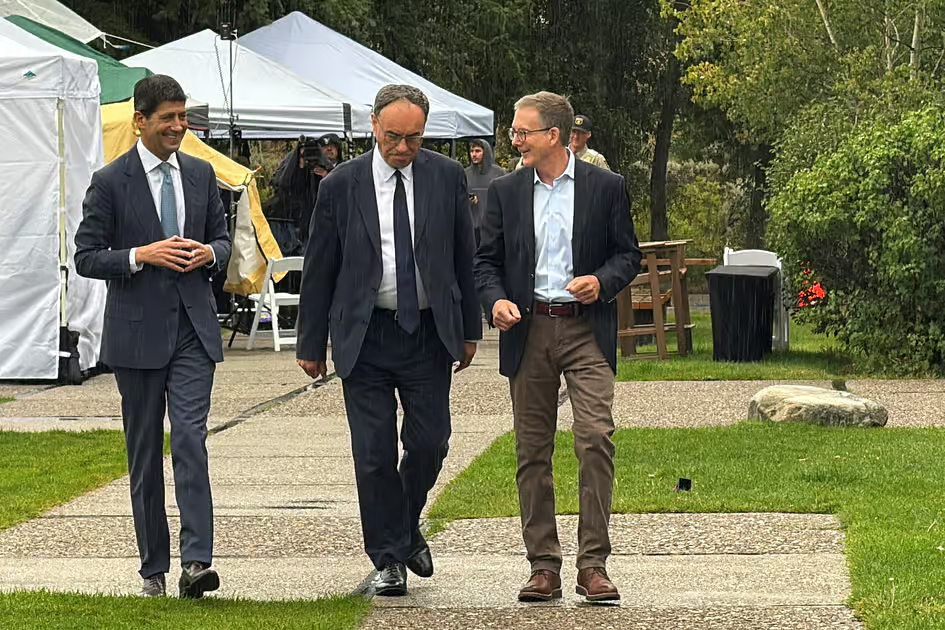
The Bank of England kept interest rates on hold on Thursday but warned they might have to go up if the Iran war drags on, while predicting British inflation will top 4% early next year.
The BoE’s Monetary Policy Committee voted 6-3 to keep rates at 3.75%, in line with July’s vote and matching economists’ median forecast in a Reuters poll.
In a surprise, the committee also paused its sales of government bonds for six months and it began a longer-term overhaul of how it shrinks its debt holdings.
Despite the expected decision on interest rates, the minutes from this week’s meeting marked a clear shift in tone that positions the BoE to follow the European Central Bank and U.S. Federal Reserve by raising borrowing costs.
The Bank of Japan is expected to raise rates on Friday as the impact of the spreading Middle East conflict adds to inflation pressures around the world.
Governor Andrew Bailey said the key question of whether the energy price surge causes broader inflation pressures remained unanswered.
“That feed-through has been quite subdued, but it is early days,” he told broadcasters.
“But we’re watching this very carefully, and we will continue to do so. And we’ve given… a very, very clear message today. The longer this goes on, the more difficult this becomes,” Bailey said.
The pound fell by around half a cent against the dollar and British government bond yields dropped sharply after the announcement of no change to rates and the overhaul of the BoE’s bond-selling.
“Interest rates are at a critical cliff-edge moment,” Suren Thiru, chief economist at the Institute of Chartered Accountants in England and Wales, said. “While policy could still remain on hold this year, persistent US-Iran hostilities mean the risk of a rate hike has shifted from a possibility to a probability.”
Some analysts said they expected the BoE to raise rates only once. Asked about the market pricing almost four quarter-point hikes over the next year, Bailey said the outlook was too uncertain to judge.
Chief Economist Huw Pill and external MPC members Megan Greene and Catherine Mann again voted to raise interest rates by a quarter-point.
But this time Bailey and his deputies Sarah Breeden, Clare Lombardelli and Dave Ramsden all signalled they could back a rate rise.
Inflation risks are strenghtening
The BoE said inflation risks had tilted further to the upside since its last set of economic forecasts in July, adding the move in energy prices since then bore similarities to its “adverse” scenario that risked entrenching inflation.
While the BoE noted signs of persistent pressure were not yet showing up in wage demands or pricing by businesses, the risk was growing.
“As we do not expect to see material relief in energy prices by the time of the (next) meeting, this reinforces our conviction that the MPC will deliver an ‘insurance hike’ in November,” said Dani Stoilova, an economist at BNP Paribas.
The warning of rate hikes comes at a difficult time for Prime Minister Andy Burnham and his finance minister John Healey, who are trying to strike a positive tone about the economy before the budget on October 28.
The BoE bumped up its estimate of quarterly economic growth for the third quarter to 0.4% from its previous 0.1% estimate but said inflation — at 3.1% in August — could “now reach slightly over 4% in early 2027,” more than double its 2% target.
Previously, the BoE had forecast peak inflation of 3.2% in late 2026.
Inflation has exceeded the 2% target in all but three months over the past five years.
The BoE hardened its language on price pressures, saying: “Given the lags with which second-round effects appeared, it was not appropriate to wait too long for evidence of such effects before responding with policy.”
BoE rewrites bond sales plan
The BoE also announced a new long-term plan to unwind its stock of British government bonds, accumulated in past attempts to stimulate the economy. Active sales of gilts will be paused for the next six months while the details are finalised.
The MPC will aim to cut its holdings of gilts for monetary policy purposes to zero by 2034, while retaining long-dated gilts only to back the issuance of bank notes.
It said it would sell its gilts that are due to mature
between 2035 and 2049 back to the government, with full plans
due before April 2027. Short-dated gilts due before 2035 will be
held until maturity.
It will effectively leave the government’s Debt Management
Office in full control of gilt issuance to the secondary market.
Source: Khaleej Times