


For years, festive decor followed a familiar script. Reds, golds, a flurry of new cushions and a dining table that looked straight out of a décor store’s catalogue. With festivities around the corner, that is now changing.
The festive season stretches from Diwali to New Year, and it’s no longer about how much you put out. It is about how much feeling and nostalgia you bring in. The conversation has shifted from what is trending to what will stay.
“The home is not something you redo every season,” says Anita Lal, founder and creative director of Good Earth. “But what people are returning to this year feels like three things.”
The first is quiet maximalism. The second is light as decor. The third is the heirloom table. It is a pattern echoed by every interior designer KT LUXE spoke to for this festive edition.
1. Quiet maximalism
This year’s festive season is about maximal intention. Dubai has never been short of grandeur, but as Jai Sharma, founder of Envelop Designs Arabia, puts it, “Luxury is evolving from simply being seen to being felt.”
Designers are calling it curated maximalism or tactile maximalism. The idea is the same. Fewer pieces, but each with weight and story.
“Move away from flat, glossy surfaces towards rich, touchable depth,” says Suparna Handa, managing director at Sarita Handa. “Delicate embroidery, slubbed silks, handloomed linens, and deep quilting create drama through feel rather than sheer shine.”
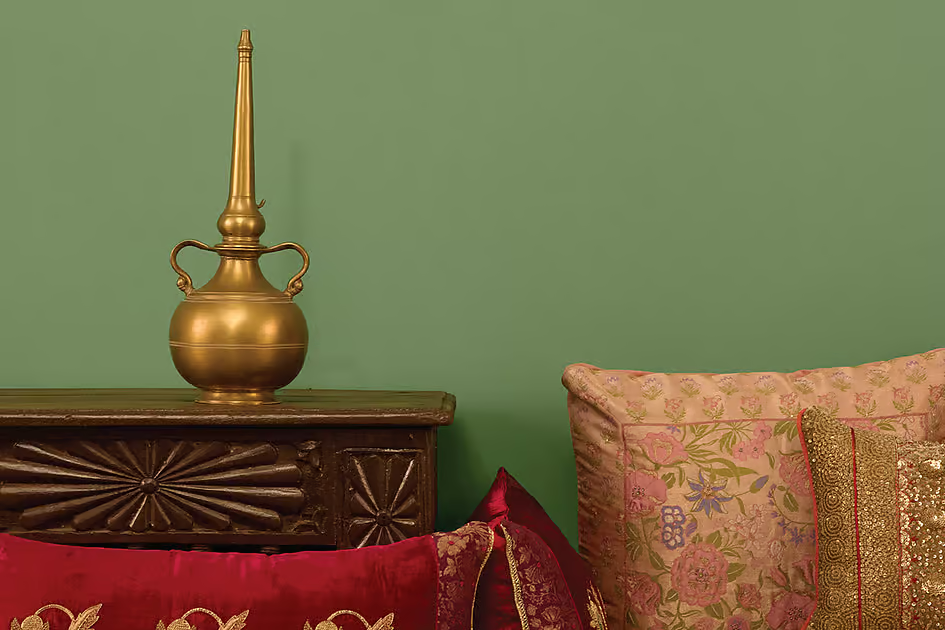
Anita Lal describes it similarly. “The more is more spirit of festive decor is still here, but it is more considered. Think one sculptural brass centrepiece instead of 10 small accents, or a richly embroidered runner layered over linen.”
In practice, this means an oversized floor bolster instead of six matching cushions. A single hand-carved stone vessel instead of a cluster of small vases. It photographs beautifully, but more importantly, it starts a conversation.
2. The mood is the material
In the Gulf, festivity happens after sunset. Diwali, the winter social calendar, long dinners on the terrace. Light, therefore, is not an accessory anymore. It is the decor.
“We are seeing lanterns, pierced metal votives and hand-blown glass hurricanes used in clusters to create mood rather than just brightness, with shadow play becoming as important as the object itself,” notes Anita Lal.
For Suparna Handa’s festive edit, low warm light is non-negotiable. Diyas, fanous, brass tea lights placed at varying heights over a textured runner bring a glow that overhead lights never can.
Create more experiences while you celebrate, as Jai Sharma puts it. “Beyond Instagram-worthy decor, homes are becoming immersive environments where lighting, fragrance, technology and personalised details come together to create experiences that stay with you long after the celebration.”
3. The Heirloom table
The third shift is the most personal. The festive table is no longer meant to look new. It is meant to look collected over generations.
Anita Lal calls it the heirloom table. “People want tablescapes that feel collected over generations: mismatched but curated brassware, hand-painted ceramics and vintage-inspired serveware that tell a story.”
This is where conscious luxury comes in. Instead of buying a whole new festive set every year, designers are urging clients to build on what they have.
“A much-loved platter, a set of handcrafted metalware or a treasured textile can become part of a new setting simply by being styled differently,” says Anita Lal. “For us, glamour and responsibility are not opposing ideas. True luxury is the ability to celebrate generously while making thoughtful choices.”
Jai Sharma echoes that sentiment sharply. “Excess and luxury were never actually the same thing, excess was always just the easiest way for people unsure of anything subtler to signal it. Real luxury has always been about intention.”
Festive decor is no longer about lavishness, it is about story. Homeowners want collectable pieces, such as hand-embroidered textile art, hand-carved stone vessels and heritage weaves, that spark genuine conversation.
4. Beyond Red and Gold
If you ask every luxury decor brand what they are retiring this year, they will say the obvious red and gold.
“Reds and golds are not wrong, they are simply the obvious answer, and the obvious answer rarely lingers in anyone’s memory,” says Jai Sharma. His studio this year built a celebration from over 600 hand drawn illustrations. “What struck me most was how alive that made the space feel, nothing polished into uniformity, everything carrying a trace of the hand that made it.”
Anita Lal is leaning into jewel tones balanced with softer neutrals, botanical greens, muted rose, ivory and earthy hues. The richness comes from material, not just colour.
“The interplay of textured and lustrous surfaces, hand painted details, tactile textiles and the warmth of traditional metals creates a richness that is felt as much as it is seen,” says Anita Lal, pointing to crafts like Naqashi painting and Kansa metalwork.
Suparna Handa’s palette for the Gulf is more grounded. “Deep terracotta, olive, muted ochre, burnt umber, and soft champagne tones that work well with raw linen or warm ivory. Add diyas, fanous or even lanterns to complete the look.”
The new luxury is in texture. Matelasse quilting, French knot needlework, hand forged metal where you can still see the maker’s hand. When rendered in tonal palettes, embroidery catches candlelight in a way that feels subtle-yet-deeply luxurious.
5. Arabesque meets Indian craft
Décor enthusiasts have always loved a global home. An Arabesque arch, an Indian textile, a European silhouette in one room. The trick, designers say, is not to force fusion.
“The secret to a global home is recognising that regional heritage does not need to be loud or literal, it lives in shared craft traditions,” says Suparna Handa. “Whether you look at Arabesque lattice work, Mediterranean tiles, or Indian embroidery, there is a common language of geometry, nature, and handcraft.”
Good Earth’s design philosophy has been built on that dialogue. “Our approach is rooted in Indian craft traditions, while drawing inspiration from the rich cultural exchanges that have shaped the world,” notes Anita Lal. Their Chahar Bagh store in Dubai draws from Persian garden traditions and the historic Silk Route.
For a hero piece that captures this, Anita Lal points to Esmeralda, a sculptural candelabra crafted in rock crystal, Belgian crystal and handcrafted brass where each leaf is individually cast and welded. “The interplay of crystal and brass creates a striking balance between organic forms and refined opulence, making the piece equally at home in a contemporary Dubai interior or a more traditionally layered festive setting.”
Suparna Handa’s hero décor piece is different but the thought is similar. An oversized, hand-embroidered textile wall art that translates the geometry of traditional needlework into a bold graphic statement. “Hung above a low majlis seating area or behind a dining table, framed by the warm glow of pierced brass fanous lanterns, it brings depth, history, and quiet sophistication in a single frame.”
Every designer has the same golden rule: anchor and edit. “Create a composition rather than a display. Begin with one anchor piece and build around it, leaving room for the eye to rest,” says Lal.
Handa starts with one heavily textured runner and builds horizontally, not vertically, with low stone bowls and floating blooms. Jai wants you to design for discovery, not display. His parting thought? “Restraint around one object with real weight to it, rather than an arrangement of many good ones.”
That is the new festive luxury. Not more, but meaningful.
Source: Khaleej Times