


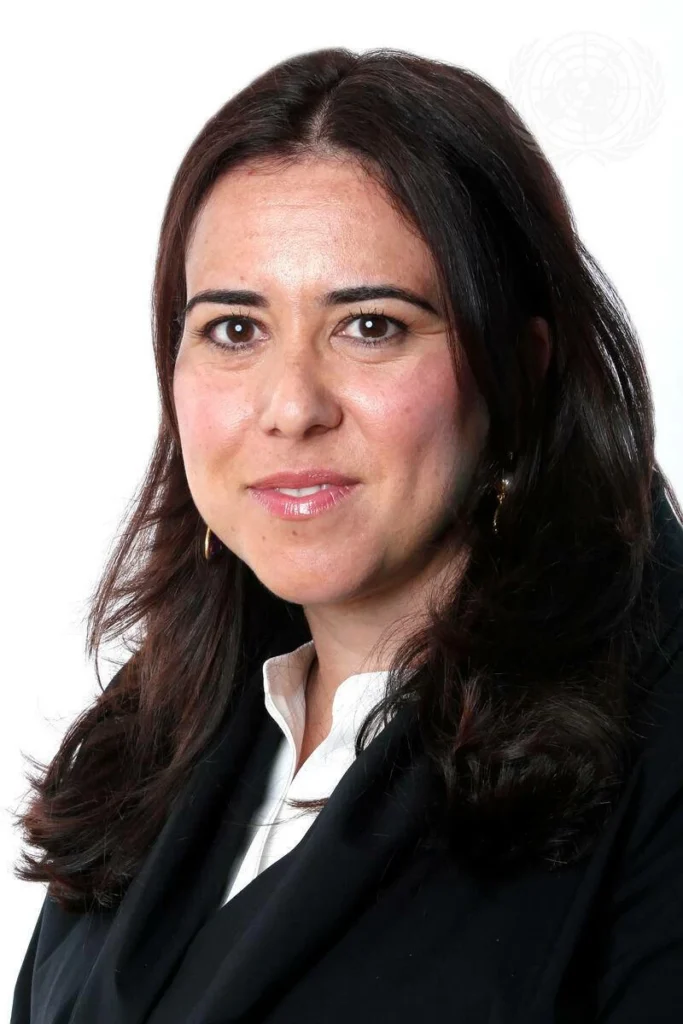
New York: Lana Nusseibeh, UAE Minister of State and Envoy to the UN and EU, has announced her candidacy to become the next UN Secretary-General, following her formal nomination by the United Arab Emirates.
Her candidacy comes following the Security Council’s latest straw poll on October 16, held as part of the process to select a successor to António Guterres, whose second term ends on December 31, 2026.
Launching her candidacy, Nusseibeh said: “I have spent much of my professional life working in and around the United Nations, and I have seen first-hand what determined diplomacy can achieve – countries with profound differences finding common ground, and agreement where people said agreement was impossible.
But I have also seen the cost when diplomacy falls short. When the distance between what we promise and what we deliver grows, trust erodes, and so does our ability to act. I am standing to be Secretary-General because I believe this is a moment to act with greater urgency: to act earlier, bring people together across difference, and drive the work forward until it produces concrete results. That is how we rebuild trust in the United Nations and ensure it delivers meaningful change for the people it exists to serve.”
Nusseibeh has taken a leave of absence from her position in the UAE Government to focus on her candidacy.
“I wish to offer myself to this office as I would serve it: speaking frankly with every government and answering to none.”
Her Vision Statement puts peace and security at the centre of her programme. It argues that the UN must become more active in preventing conflict, preserving channels for diplomacy and helping divided parties find practical points of agreement.
Alongside that peace and security proposition, Nusseibeh sets out how the organisation itself must reform to deliver more effectively across the UN’s three pillars of peace and security, development and human rights. Her programme calls for clearer priorities, leadership and resources closer to the problems the UN exists to solve, stronger accountability for results, less duplication and empowering people to deliver on the field.
Peace and Security: Put the UN back at the table
Nusseibeh says the United Nations should use quiet diplomacy to keep disputes from escalating and pursue practical agreements that can reduce suffering now while creating space for wider political settlements.
Her Vision Statement prioritises achievable “first agreements” such as humanitarian access, prisoner exchanges and local truces, backed by persistent diplomacy and verification that agreements hold.
It also puts “first actors” at the centre of peace efforts: those closest to conflicts, regional organizations and mediators trusted by the parties. Nusseibeh argues that the UN need not lead every process, but should be ready to work with those best placed to make progress and be present in every room where it can add value.
Her approach is rooted in bridge-building with a purpose: finding common ground across geopolitical divides not simply to sustain dialogue, but to produce an agreement, secure access, reduce violence or create the conditions for a broader peace.
A UN built to deliver
Nusseibeh argues that stronger diplomacy requires an organization capable of backing it up. Her reform programme is therefore focused on making the UN faster, more focused and more accountable so it can deliver effectively on peace and security, development and human rights.
She also proposes that every major Secretariat programme report what it achieved against what it cost, while tackling duplication and moving leadership and resources closer to where they can make the greatest difference.
She would also give officials clearer purpose and empower people in the field to act and deliver, reward results and build a senior team chosen for excellence that reflects the world it serves and the principles the UN upholds. A more focused United Nations, she argues, should do less where others can deliver and more where only it can.
Development: Results a country can point to
Nusseibeh argues that the UN development system must respond to a changing world in which progress on the 2030 Agenda for Sustainable Development and the SDGs remains deeply uneven, particularly in countries affected by conflict and fragility. Aid remains essential where it is needed, but the UN must also help countries pursue nationally determined priorities and build durable prosperity.
Her programme would focus development cooperation on national priorities, put jobs at the centre, expand development opportunities in fragile settings, address the mispricing of risk, champion fairer debt solutions and build new partnerships with philanthropy and the private sector. As Member States prepare to negotiate the successor to the 2030 Sustainable Development Goals, she would use the Secretary-General’s convening role to help forge commitments that governments can explain to their citizens and whose promises the world can keep.
Human rights and the challenges of tomorrow
Nusseibeh says human rights, peace and development are mutually reinforcing and that the UN’s credibility in upholding human rights depends on applying the Charter, international law and universal human rights consistently and without double standards.
On artificial intelligence and biotechnology, she proposes using the UN to build practical international cooperation before divisions harden, including voluntary incident reporting, and broader participation by countries that live with these technologies but do not build them. She also calls for the UN to help Member States anticipate the effects of climate change and strengthen resilience where fragility is greatest.
UN experience
Nusseibeh served as the UAE’s Permanent Representative to the United Nations from 2013 to 2024, including throughout the UAE’s 2022-2023 term as an elected member of the Security Council, which she twice served as President. She also served as a Vice-President of the General Assembly, President of the Executive Board of UN Women, worked on General Assembly revitalisation and Security Council reform, and twice served as President of the Security Council during the UAE’s 2022-2023 term.
Her UN work has covered peace and security, humanitarian diplomacy, sustainable development, women, peace and security, human rights and multilateral reform.
Her full Vision Statement, A United Nations for the Next Eighty Years, is available at www.lananusseibeh.org.
Source: Emirates 24|7