


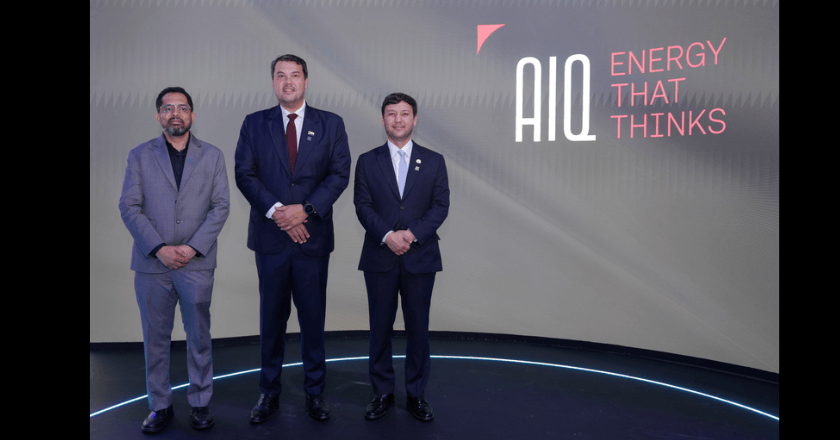
AIQ’s senior leadership outlines how agentic AI, intelligent automation and human oversight are transforming energy operations, strengthening resilience and driving international growth
Artificial intelligence is moving beyond experimentation to become an integral part of energy operations, enabling greater efficiency, reliability and operational intelligence. At ADIPEC 2026, UAE-based AIQ reinforced this transition with the introduction of Genesis, its AI-native operating system for energy, signalling a shift towards coordinated AI systems capable of delivering measurable commercial and operational value.
Building on successful deployments across the UAE, AIQ is expanding its international footprint, including a major computer vision engagement in India, while advancing AI-driven capabilities across energy production, trading intelligence and industrial workflows. Its RoboWell autonomous well control solution, deployed across more than 500 wells, has delivered up to 30 per cent optimisation in gas-lift consumption, demonstrating the practical impact of AI in live energy environments.
Central to AIQ’s strategy is the integration of specialised AI agents within secure, transparent and governed operational frameworks, ensuring that automation enhances human decision-making rather than replacing critical expertise.
Dennis Jol, Chief Executive Officer; Saravan Penubarthi, Chief Technology Officer; and Nurlan Turniyazov, Senior Vice President – Operations, AIQ, spoke to Tahawultech.com about the company’s international growth ambitions, the technical foundations of agentic AI, measurable operational gains and the evolving role of human oversight in building an AI-native energy workforce.
Interview excerpts
How is AIQ translating its experience in the UAE into international growth, and what priorities guide your expansion into markets such as India?
Dennis Jol: ADIPEC 2026 showed how far that journey has come. We introduced Genesis, the world’s first AI-native operating system for energy; signed agreements with international technology providers, and agreed the engagement of Genesis with a customer domestically. All of this momentum rests on proving our solutions in live operations at scale at home.
The UAE provided us a clear advantage: one of the most demanding operating environments in the world, and an AI ecosystem where energy operators, model developers, data center and cloud providers, and application developers work together. The country is moving from importing technology to exporting it. We are part of this milestone evolution.
Abroad, our approach is to begin with the most significant challenge an operator faces, scope it, pilot a solution, and if successful, scale for measurable results. In India, for example, we have a large-scale, multi-year commercial computer vision engagement with a leading industrial conglomerate. We also have activities at varying stages in Egypt, Kuwait, Vietnam, Kazakhstan, Indonesia, Malaysia, and Colombia, and see significant opportunities in North America.
What will determine whether coordinated AI can deliver commercial value and strengthen energy security at scale?
We believe three things. The first is where AI is deployed. The real question is no longer whether AI can create positive impact in industrial operations, but whether it is deployed where it creates value: inside live operations, against a clear business case, with results that can be measured.
The second is fragmentation. A significant barrier to scale is disconnected applications, models and agents. Operators benefit most when the systems they have already invested in work together as one, which is why AIQ has evolved from building individual applications to orchestrating them.
The third is ownership. Value in energy is shifting from physical capacity to digital capability, and those who turn data into actionable outcomes will lead. Operators that leverage their data and domain knowledge build lasting resilience. That is where energy security comes in: intelligent energy is secure energy, because a system that sees across all its assets responds faster when conditions change.
How does AIQ coordinate specialised AI agents across complex energy workflows while maintaining reliability, security and transparency?
Saravan Penubarthi: Coordination has to be designed in, not bolted on. Our Genesis AI native operating system from energy workflows achieves this by being a single operating layer: one place to deploy, run, and maintain models, agents, compute, data stores, and data flows. Inside it, 40+ models and agents sit across seven capabilities, live today with operators, working on real assets. TradeX, our trading intelligence platform, shows what coordinated agents look like in practice. Three agents, covering markets, brokers, and operations, each with a defined role, watch seven live channels around the clock and turn more than 1,400 data feeds into risk-scored opportunities in under a minute. Every opportunity comes with plain-language reasoning, a confidence score and an audit trail that compliance can replay. Transparency runs through every layer. Operators see the data, the logic, and the plan before anything is executed, and can modify it. TradeX proposes, the trader approves.
Reliability starts with data. Our models are trained on more than 40 petabytes of real field data rather than synthetic information, so agents are built for the conditions they will actually face.
What technical safeguards are essential when integrating agentic AI into critical operational systems?
Bounded autonomy. Agents should act only within limits engineers define, on repetitive, well-bounded tasks. Complex, unscripted decisions, novel conditions, and anything safety-critical ought to have significant human oversight, with every action being traceable. The second is access control at the level of every request. In DocuX, our AI document controller, for example, every user sees only what they are cleared for, and every exchange is logged in a tamper-evident audit trail. The third is data sovereignty: our applications run inside the customer’s own data and regulatory environments, edge as well as cloud, with encryption, privacy-preserving analytics where appropriate, and nothing used to train public models. The fourth is openness. Systems should be verifiable and not locked to a single model or vendor, so operators can inspect them, audit them and switch to the best available model. Open, agnostic, transparent, and verifiable design is what lets operators trust autonomy enough to use it.
What measurable improvements in productivity, safety and reliability has AIQ achieved through its offshore well deployments?
Nurlan Turniyazov: All of our solutions are based in business cases that help operators produce more, work more efficiently, improve safety, or support sustainability efforts. RoboWell, our autonomous well control solution, for example, runs on more than 500 wells and has delivered up to 30% optimisation in gas-lift consumption. Productivity also changes for the people running the wells. RoboWell keeps wells flowing at target rates as conditions change, so engineers manage by exception rather than adjusting each well by hand. On safety, fewer physical interventions mean fewer trips offshore, which reduces risk exposure for crews and lowers emissions.
Reliability comes from operating inside the limits engineers set, with people overseeing every well and every action.
How are operational teams adapting to working alongside AI agents, and which decisions still require human oversight?
Upskilling staff is the key to adaptation – having the workforce learn to supervise tasks outsourced to AI. AI has the incredible ability to take on repetitive work, so engineers can spend more of their time on exceptions and strategic responsibilities. We are here to make experts better, not to replace them: they have access to more information and insights, faster. Adoption follows trust, and trust follows collaboration and a sense of ownership. Teams take to AI when they can see the reasoning, check the plan, and override it. At AIQ, energy subject matter experts sit alongside data scientists, so solutions are developed with operations teams rather than delivered to them. Some decisions stay firmly with people, supported by insights from AI: complex, unscripted situations, novel conditions, anything safety-critical, and setting the operating limits agents work within. As experienced engineers retire, embedding their knowledge in AI systems keeps that expertise within the organisation, and spreads it across teams. That is how an AI-native workforce is built.
Source: Tahawul Tech